







Advice based on our own product information and knowledge base, not medical advice.
Hearing protection leak test: what it is, who needs it and how often

A custom earmould only protects you if it seals properly, and your ear canal changes. Read what a leak test is, who needs it, how often and what happens if your earplug no longer seals.
Take the next step for your hearing
A custom earmould, hearing protection made to measure, only protects you if it seals your ear canal properly. If there’s a gap somewhere, sound leaks past it, however good the filter is. You can’t see that from the outside and usually you can’t feel it either. That’s why the leak test exists: a short measurement that shows whether your earplug still seals airtight.
In short
- A leak test uses a little air pressure to measure whether your custom earmould still seals. It takes about five seconds per ear.
- Your ear canal changes over the years, which can make the fit less good.
- For work, we recommend a leak test when they are first used and every year after that. The EU rules don't set a fixed interval.
- We record the measurement results per employee. We also test custom earmoulds from other brands.
- We still do the leak test, but we prefer the audio test: it measures how much your earplugs attenuate in your own ear.
Our preference: the audio test
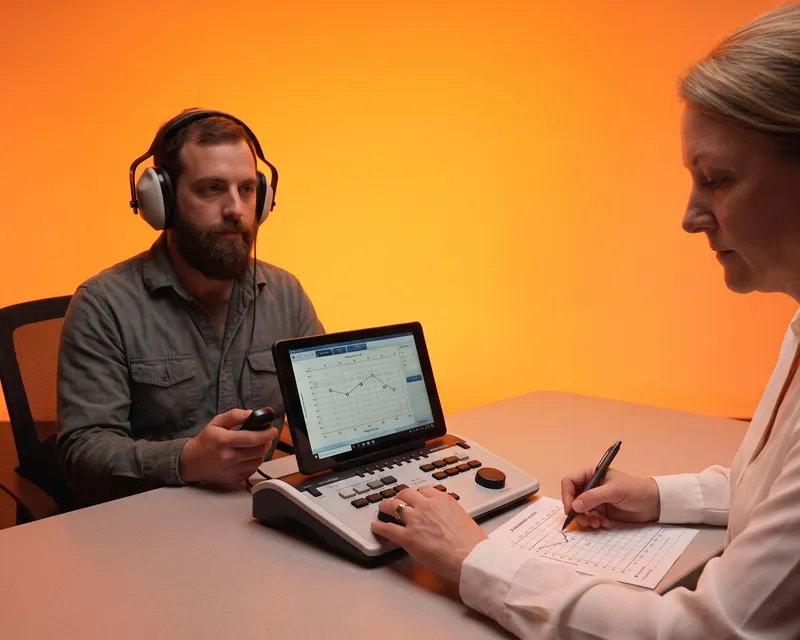
The leak test shows whether your custom earmould seals. With the audio test we also measure how much it attenuates: we use the audiometer to determine your hearing thresholds without and with your earplugs, and the difference at each frequency is the attenuation you get in your own ear. We do this test at our locations and at businesses on site, with results and records per employee. You can read how it works in hearing protection fit test.
What is a leak test?
In a leak test we check whether your custom earmould sits airtight in your ear canal. An earplug that doesn’t let air through doesn’t let sound past the edge either. This is how the test works:
- 1We clean your custom earmoulds. First they go through an intensive ultrasonic clean.
- 2You put them in yourself. We connect a thin air tube to them.
- 3We build up a little pressure. About 5 millibar, in your ear canal. You barely notice it. If the pressure holds, the earplug seals properly.
- 4After about five seconds the measurement is done. Then we test the other ear. We record the measurement results, so you can look back later at how the earplugs sealed.
Because we test the earmoulds in your own ears, we measure exactly what counts: how the earplug sits in your ear canal. We can test almost all custom earmoulds, including those from other suppliers.
Why the fit changes
Your ears keep changing a little throughout your life. A British study by GP James Heathcote (BMJ, 1995) showed that the outer ear grows by an average of 0.22 mm a year. The ear canal changes too: it is partly made of elastic cartilage and can change shape as a result. A significant weight gain or loss also plays a part.
Over time, a gap can form between your ear canal and the earmould, and sound can leak through it. That says nothing about the quality of the earplug, only about the fit. That’s why we use 4 years as the moment for a free check.
Who needs a leak test?
Mainly employers. Hearing protection against harmful noise is personal protective equipment (PPE) in the highest category, and an employer has to make sure that protection actually works. Under the EU Noise Directive, workers must wear hearing protection from 85 dB(A), and the employer has to check that the measures are effective. Then you also want to know for certain that it still seals. A leak test with recorded measurement results shows that in black and white. Read more about when hearing protection is mandatory.
In noisy sectors, such as the metal industry or a printing works, employees wear their custom earmoulds every day. A good seal counts double there.
If you wear your earplugs privately, for music, sleeping or the motorbike, a leak test isn’t mandatory. If you notice you hear more than you used to, or that the earplug sits more loosely, come in for a check.
How often should a leak test be done?
The EU rules don’t set a fixed interval: not the Noise Directive and not the PPE Regulation. Check whether your national rules do. Our advice for hearing protection at work: a leak test when the earplugs are first used and periodically after that, preferably every year. That way you see in time when a set no longer seals properly, before an employee is less protected without noticing. Also test in between if someone’s weight has changed a lot or they say the earplug feels different.
What if a custom earmould no longer seals?
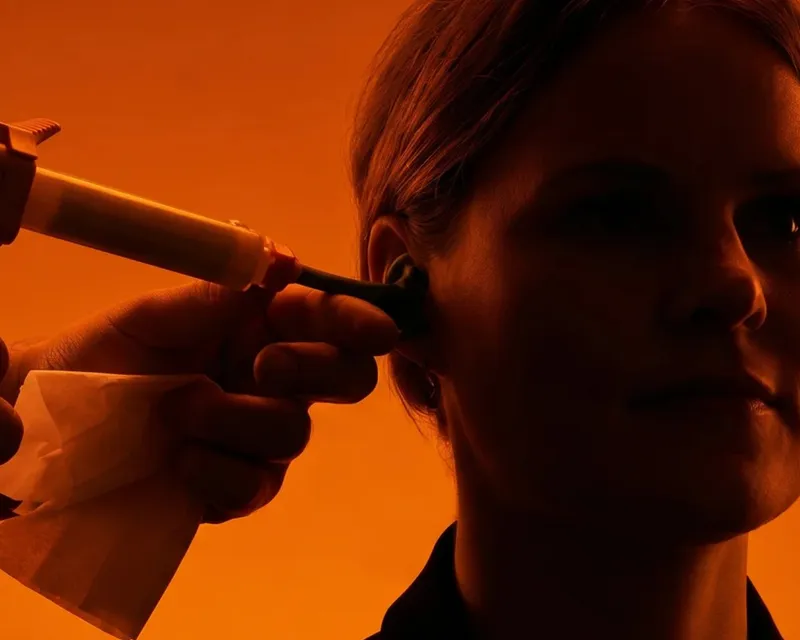
Then we look at what’s needed. Sometimes adjusting the earplug is enough. If the shape of the ear canal has changed too much, we take a new impression and make a new set. How a fitting works, you can read in fitting earplugs: how it works.
Leak test or online fit test?
We prefer the audio test: a fit test with the audiometer, at one of our locations or at your workplace, that measures the attenuation in your own ear. We keep doing the leak test as a quick check of the seal. We also have an online audio fit test. The leak test and the online test complement each other like this:
Leak test
Uses air pressure to measure whether your custom earmould seals airtight. We do it, at your workplace or at one of our locations, and we record the measurement results. A quick check of whether the earplug still seals; if you also want to know the attenuation, choose the audio test.
Online fit test
You do it yourself, in a quiet room, with your own custom earplugs. You hear a series of tones per ear, and the test shows whether the seal is still right. Takes six to fifteen minutes. Handy between two checks. Take the fit test
PPE rules: what applies to hearing protection?
If you look up the rules for hearing protection as PPE, you come across two kinds of rules: those for the product and those for the workplace.
The product: EU Regulation 2016/425. Under the PPE Regulation (EU) 2016/425, hearing protection against harmful noise falls under category III, the highest and strictest PPE category. The regulation has applied since 21 April 2018. Until 21 April 2019 manufacturers could still place products on the market under the old directive. For category III, a notified body approves the product and also supervises production. Earplugs are tested to the EN 352-2 standard and carry a CE marking. The regulation is aimed at manufacturers, importers and distributors and at the products they place on the market.
The workplace: the Noise Directive 2003/10/EC. What the employer has to do isn’t in the regulation but in the Noise Directive (2003/10/EC), articles 3 and 6. From 80 dB(A) the employer must make hearing protection available, from 85 dB(A) workers must wear it, and 87 dB(A) is the limit value in the ear, with the hearing protection taken into account. These are the EU minimum rules (Directive 2003/10/EC). Every EU country has written them into its own law, and some countries are stricter, so check your national rules. In the Netherlands, for example, they are in the Working Conditions Decree (Arbobesluit), article 6.8.
For businessesOn-site leak test, with recorded resultsWe test your team's custom earmoulds at your workplace, including those from other brands. Request a quoteYou can read more about hearing protection for your team at hearing protection for work and custom earplugs.

Got a question? We're all ears.
Frequently Asked Questions
Read MoreFAQ
The EU rules do not set a fixed interval; check whether your national rules do. For custom earmoulds at work, we recommend a leak test when they are first used and periodically after that, preferably every year. If you wear them privately, we use 4 years as the moment for a free check, or sooner if you notice you hear more than you are used to.
Our leak test is meant for custom earmoulds: we connect a thin air tube to the custom earplug and measure whether the pressure in your ear canal holds. That cannot be done in the same way with universal earplugs. Other fit tests exist for universal hearing protection, often via the manufacturer.
Yes, we can test almost all custom earmoulds, including those from other suppliers.
For a leak test on site we do not issue a certificate, but we record the measurement results per employee. That way, as an employer, you can show that the hearing protection still seals properly.
The leak test uses air pressure to measure whether your earplug seals airtight, and we do it at your workplace or at one of our locations. You do the online audio fit test yourself at home with a series of tones per ear; it shows whether the seal is still right and whether it is better to come in.
The leak test uses a little air pressure to measure whether your custom earmould seals airtight. In the audio test we use the audiometer to measure your hearing thresholds without and with your custom earplugs; the difference at each frequency is the attenuation you get in your own ear. We do both at one of our locations or at your workplace, with records per employee. We prefer the audio test, because it shows not only whether the earplug seals, but also how much it attenuates.
Related blog articles

When Is Hearing Protection Mandatory? 80, 85 and 87 dB(A) Explained
Custom earplug fitting: how it works, step by step
Hearing protection fit test: how we measure how much your earplugs attenuate