





Advice based on our own product information and knowledge base, not medical advice.
Hard or soft custom earplugs: material, colour and which one suits you

What is the difference between hard (acrylic) and soft (silicone) custom earplugs? Compare comfort, hygiene, heat, helmets and sleeping, and read which colours you can choose.
Take the next step for your hearing
We make custom earplugs in two materials: hard acrylic and soft silicone. With many models you choose yourself, and then the question usually follows: what’s the difference? Below you can read what each material does well, which one suits your use, which products come in which material and which colours you can choose.
In short
- Hard (acrylic) is smooth, hygienic, easy to clean and comfortable in the heat.
- Soft (silicone) gives way, takes less getting used to and is more comfortable under a helmet and for sleeping.
- The attenuation depends on the filter and the fit, not on the material.
- Silicone comes in many more colours; acrylic in transparent, red, blue and black.
Hard custom earmoulds: acrylic
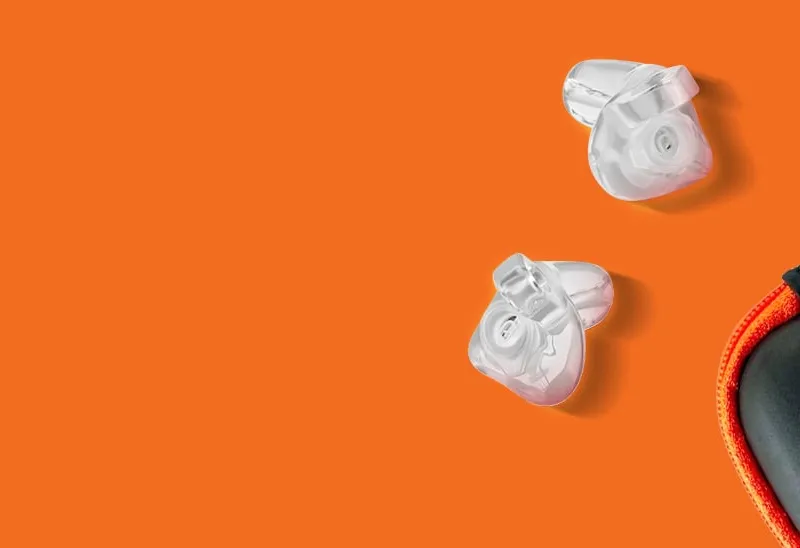
We make hard custom earplugs from acrylic. That’s a hard, smooth plastic. Thanks to the smooth surface the earplugs slide in and out of your ear easily, and they’re simple to clean, even when there’s some residue on them after long wear.
Acrylic is also comfortable in warm conditions. That’s why we often recommend a hard version to people who work in a bakery or a hot production hall, for example. The material hardly wears and lasts a long time.
The downside: acrylic doesn’t give. If a hard earplug is just slightly tight in one spot, it can start to press after long wear, think of more than five hours in a row. A good fit is therefore extra important, and that’s what our 6-month comfort guarantee is for.
Soft custom earmoulds: silicone
We make soft custom earplugs from silicone. It’s flexible and moves with your ear canal, which changes shape slightly when you talk and chew. That’s why silicone usually takes less getting used to.
Silicone sits comfortably under a motorcycle helmet (see our motorcycle earplugs and music and navigation on a motorcycle), a cap or headphones, because there’s no hard edge pressing against your ear. Flying with a Bose headset? Then we also make custom sleeves for the Bose ProFlight. And if you sleep on your side, soft material is really a must: that’s why we always make our sleeping earplugs from silicone. Musicians often choose silicone because they wear their earplugs for hours.
Silicone also lasts for years with good care. You clean it with lukewarm water and a mild soap; how best to do that, you can read in how to clean earplugs.
How soft is soft? Shore A explained
The hardness of silicone is expressed in Shore A, a scale for soft materials such as rubber and silicone. The higher the number, the harder. The silicone of the Audinc Fly, for example, has a hardness of 40 Shore A: soft enough to give, firm enough to seal the ear canal properly. For sleeping earplugs we also have an extra soft version. Acrylic is a hard plastic and falls outside the Shore A scale. The short answer is also in our FAQ on the material of custom earplugs.
Hard and soft earplugs side by side
| Hard (acrylic) | Soft (silicone) | |
|---|---|---|
| Comfort | Smooth and easy to put in; can start to press after many hours | Gives way, less getting used to, comfortable for long wear |
| Lifespan | Hardly wears, lasts the longest | Also lasts for years with good care |
| Hygiene | Smooth surface, the easiest to keep clean | Easy to clean with lukewarm water and mild soap |
| Heat | Comfortable in warm conditions | Suitable, but acrylic is preferred here |
| Under a helmet | Possible, but a hard edge can press | Comfortable under a helmet, cap or headphones |
| Sleeping | Not suitable | Yes, also in an extra soft version |
| Colours | Transparent, red, blue, black | Wide choice, including glow in the dark and glitter |
Does your voice sound different? The occlusion effect
With any earplug that seals your ear canal, your own voice can sound a little hollow or muffled, as if you’re talking with your fingers in your ears. That’s called the occlusion effect. It depends mainly on the fit, how deep the earplug sits in your ear canal and the ventilation, not on the material. So a soft earplug doesn’t automatically sound more natural than a hard one. Why depth makes such a difference, you can read in earplugs too deep in your ear.
Which product comes in which material?
Not every model is available in both materials. This is the current situation per product:
| Product | Hard | Soft |
|---|---|---|
| Custom Music (music) | Yes | Yes |
| Custom Work (work) | Yes | Yes |
| Custom Motor | Yes | Yes |
| Custom Hobby | Yes | Yes |
| Custom Porto (two-way radio) | Yes | Yes |
| Custom Pure Tones | No | Yes |
| Custom SleepzZ (sleep) | No | Yes, standard or extra soft |
| Dry Ears (swimming) | No | Yes, also floating |
| Custom Impulse (shooting) | No | Yes |
Not sure? During the fitting you can hold both materials and compare them. How that appointment goes, you can read in fitting earplugs: how it works.
Which colour earplugs do you choose?
Besides the material, you also choose the colour. Soft silicone offers the widest choice. For most models these are the standard colours:
The colour swatches give an impression; during the fitting you see the real colour samples. For an extra charge, soft silicone also comes in glitter, in blue, gold, pink or purple. Hard acrylic comes in transparent, red, blue and black. Exactly which colours are available differs per product; you’ll see them when you configure your earplugs on the product page.
A few choices that come up often:
- Transparent is the least noticeable. You can see the filter inside the earplug.
- Beige is close to a skin tone, so it’s discreet too.
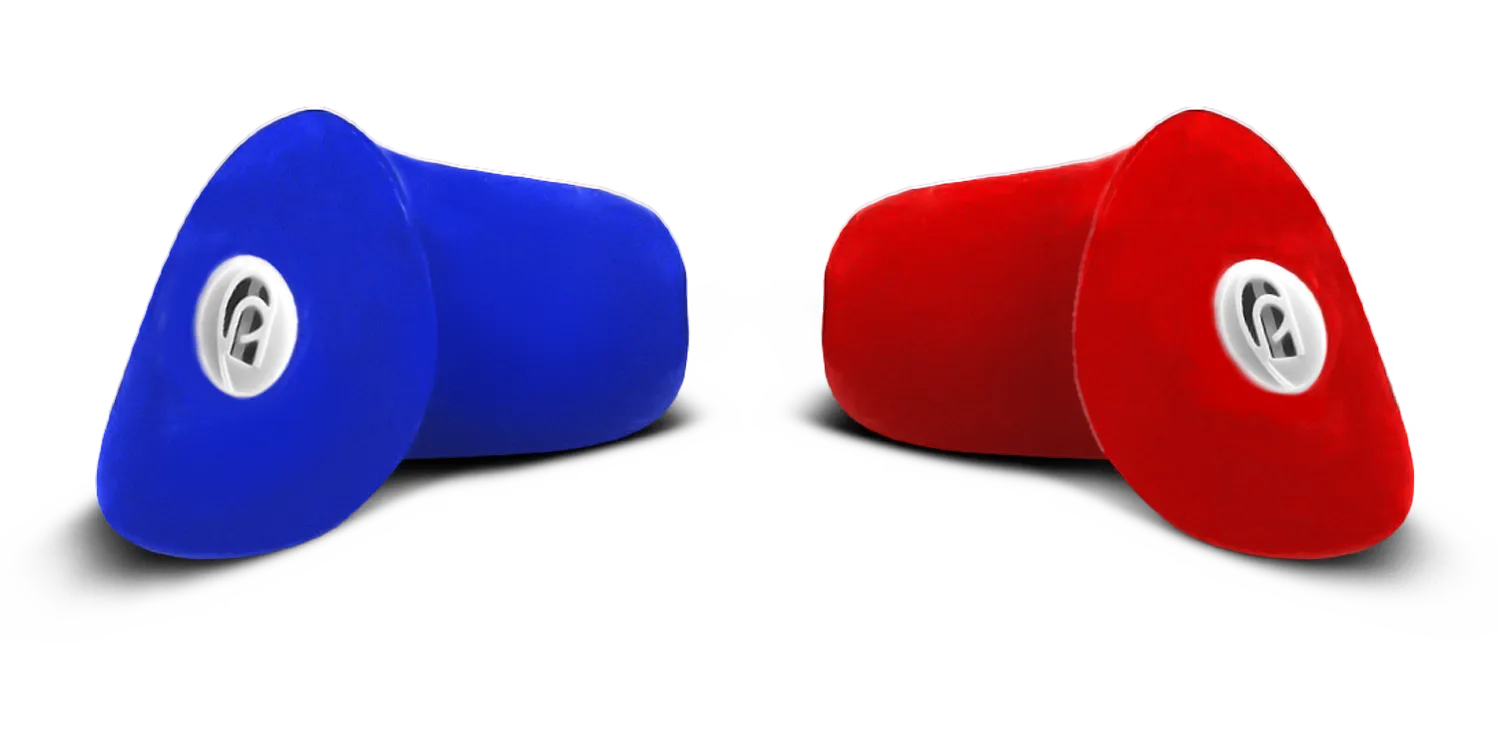
- Red on the right, blue on the left makes it easy to tell your left and right earplug apart, handy if you take them in and out a lot.
- A bright colour such as yellow, orange or blue is quick to find if you drop an earplug. In the workplace, especially in the food industry, that’s a practical advantage.
Tip for the workplace
Work in a bakery or the food industry? Then choose acrylic in a striking colour. If your hygiene plan sets requirements for colour or detectability, mention that in your quote request. You can read more about the requirements per sector in industrial hearing protection.
Product finder
Which earplugs suit you?
Two questions, and you’ll see which earplug we would recommend.
What do you need hearing protection for?
Music and going out
How do you want to hear the music?
Sleep
What do you mainly want to keep out?
Work
What kind of noise do you have at work?
DIY
What do you mostly use for DIY?
Motorcycling
What matters most to you under your helmet?
Swimming and surfing
What do you want in the water?
Shooting and hunting
Do you want to keep hearing ambient sound and conversations?
Two-way radio and security
Do you also work in loud noise?
Our advice
Custom Music
€128.95
SNR 17–31 dB (Click up to 34)
A tube filter that makes music sound a little warmer, in several strengths.
At your appointment you choose the material: soft silicone is the most comfortable for long wear and under a helmet, hard acrylic lasts longer and is easy to put in.
Our advice
Custom Pure Tones
€159.95
SNR 10–23 dB (Click 28)
A flat filter that attenuates low, mid and high tones almost equally: the music stays balanced.
Our advice
In-ear monitoring
from €539.95
Isolation up to 35 dB
Your own monitor mix in your ears, with the seal of a custom earplug.
Our advice
Custom SleepzZ
€119.95
Maximum attenuation, no filter
Soft silicone and no filter, as quiet as possible. Comfortable for side sleepers too.
Our advice
Custom Work
€106.57 excl. VAT
SNR 17–31 dB (Click up to 34)
A work filter that attenuates noise while you can still understand your colleagues.
At your appointment you choose the material: soft silicone is the most comfortable for long wear and under a helmet, hard acrylic lasts longer and is easy to put in.
Our advice
Custom Impulse Work
€128.06 excl. VAT
SNR 21 dB, peak up to 34 dB
Attenuates constantly and extra hard on bangs, so you can talk normally in between.
Our advice
Custom Porto Protect
€149.00
Radio on one side, attenuation on both sides
Both ears are protected against noise and you hear your radio clearly.
At your appointment you choose the material: soft silicone is the most comfortable for long wear and under a helmet, hard acrylic lasts longer and is easy to put in.
Our advice
Custom Porto
€99.00
Ear stays open
A custom earpiece for your two-way radio that stays in place for your whole shift.
At your appointment you choose the material: soft silicone is the most comfortable for long wear and under a helmet, hard acrylic lasts longer and is easy to put in.
Our advice
Custom Hobby
€128.95
SNR 17–31 dB (Click up to 34)
Attenuates the noise of power tools while you still hear what is going on around you.
At your appointment you choose the material: soft silicone is the most comfortable for long wear and under a helmet, hard acrylic lasts longer and is easy to put in.
Our advice
Custom Impulse
€154.95
SNR 21 dB, peak up to 34 dB
An impulse filter that attenuates harder the louder the bang.
Our advice
Custom Motor
€128.95
SNR 17–34 dB (choice of filter)
Attenuates wind noise while you keep hearing the traffic around you.
At your appointment you choose the material: soft silicone is the most comfortable for long wear and under a helmet, hard acrylic lasts longer and is easy to put in.
Our advice
Custom Pure Tones Motor
€159.95
SNR 10–23 dB (Click 28)
With a flat filter: everything gets quieter but still sounds the way it is.
Our advice
Dry Ears
€119.95
Water filter (SNR 5 dB)
Keeps water out while you can still hear the lifeguard or your coach.
Our advice
Dry Music
€229.00
Waterproof MP3 player (8 GB)
Custom swimming earplugs with a built-in waterproof MP3 player and 16 hours of playtime.
Our advice
Cens
€929.00
Active: shots are attenuated automatically
Electronic: amplifies ambient sound and conversations, and attenuates shots automatically.
Having custom earplugs made
Want hard or soft custom earplugs? See all models at custom earplugs, or book an appointment: you can feel both materials, look at the colour samples and choose together with us what suits your use.

Got a question? We're all ears.
Frequently Asked Questions
Read MoreFAQ
Yes. If you sleep on your side, your pillow presses the earplug into your ear. Soft silicone gives way, hard acrylic does not. That is why we always make our sleeping earplugs, the Custom SleepzZ, from silicone, in a standard or extra soft version.
We usually recommend acrylic there. It is smooth, easy to keep clean and comfortable in a warm environment. Also choose a striking colour, such as blue, so a dropped earplug is easy to spot. If your HACCP plan sets requirements for colour or detectability, mention that in your quote request and we will look together at which version fits.
With any earplug that seals your ear canal, your own voice can sound a little hollow or muffled. That is called the occlusion effect. It depends mainly on the fit, how deep the earplug sits in your ear canal and the ventilation, not on the material.
In soft silicone, most models come in transparent, yellow, red, blue, orange, green, pink, white, glow in the dark, black and beige, plus four glitter colours at an extra charge. Hard acrylic comes in transparent, red, blue and black. Both are also available with red on the right and blue on the left. The options differ per product.
Shore A is a scale for the hardness of soft materials such as rubber and silicone. The higher the number, the harder the material. The soft silicone of our Audinc Fly, for example, has a hardness of 40 Shore A. Acrylic is a hard plastic and falls outside this scale.