







Hearing protection fit test: how we measure how much your earplugs attenuate
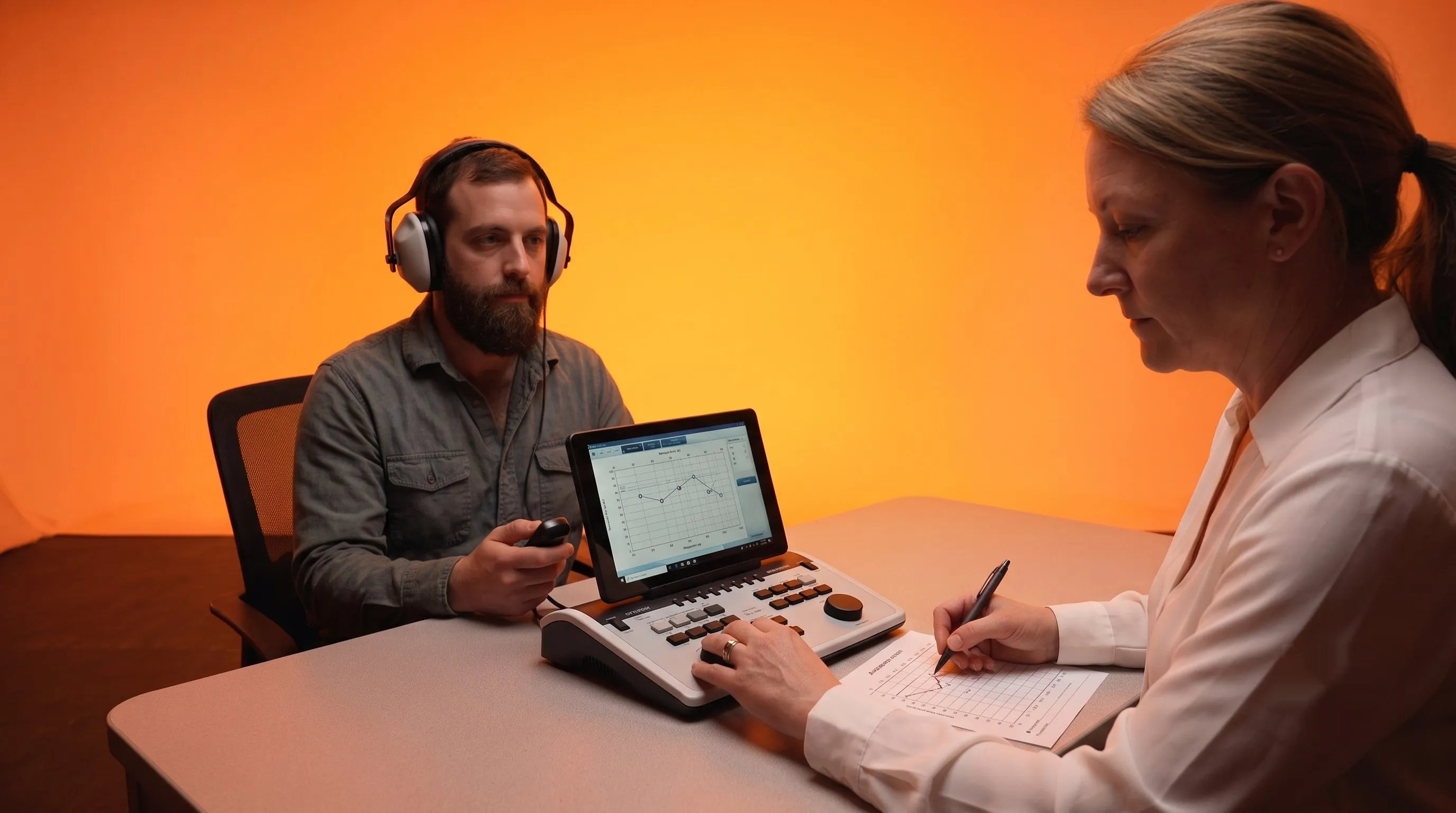
The SNR on the packaging does not tell you how much your earplugs attenuate in your ear. A fit test does. Read how the audio test works, what you get as an employee and as an employer, and when to test again.
Take the next step for your hearing
Every pack of earplugs states an SNR: the number of decibels they block. But that figure comes from a lab, not from your ear. How much your hearing protection really attenuates depends on how it sits in your ear canal. With a fit test, you measure the attenuation of your earplugs in your own ear.
In this article you’ll read why the fit makes such a difference, how our audio test works, what you get as an employee and as an employer, and when to test again.
In short
- A fit test measures how much your hearing protection attenuates while you wear it. The SNR on the packaging is a lab value; what you get can be lower.
- In our audio test we use the audiometer to measure your hearing thresholds without and with your custom earplugs. The difference at each frequency is your attenuation.
- You get a result and we record the results per employee. From 3 people we test at your workplace, otherwise at one of our locations in the Netherlands, Belgium or Paphos (Cyprus).
- We still do the leak test with air pressure, but we prefer the audio test: it measures the attenuation itself.
On-site fit test · from 3 people we measure the attenuation per employee at your workplace, with results and records.
Request a quoteWhy the fit determines how much your earplug attenuates
The SNR (Single Number Rating) on the packaging comes from a lab test to the EN ISO 4869 standard. Hearing thresholds are measured on a group of test subjects with and without the earplug, and a single figure is calculated from the differences. That tells you a lot about the product, but nothing about how the earplug sits in your ear.
In practice it can turn out differently. If the earplug doesn’t sit quite right, isn’t inserted far enough or your ear canal has changed, sound leaks past the edge. Every gap costs attenuation, and you usually don’t feel it. That can happen with custom earplugs too: your ear canal changes over the years, so an earplug that fitted well at first may seal less well later. You can read why in our article on the leak test.
That’s why the US National Institute for Occupational Safety and Health (NIOSH) has advised employers since 2025 to measure the attenuation of each worker with an individual fit test, instead of working with the figure on the packaging minus a correction (NIOSH, 2025). The result is called a personal attenuation rating, or PAR.
How does the audio test work?
In the audio test we use an audiometer to measure how quiet a tone can be while you can still just hear it: your hearing threshold. We do that twice.
- 1We measure your hearing thresholds without earplugs. You hear tones from low to high and indicate as soon as you hear one. At each frequency we note the quietest tone you can still hear.
- 2You put your earplugs in yourself. Just as you do at work. That way we measure the protection the way you actually wear it.
- 3We measure the same tones again, with your earplugs in. Because the earplug blocks sound, each tone has to be louder before you hear it.
- 4The difference is your attenuation. For each ear and each frequency, we see how many decibels your earplugs block in your ear. If the attenuation is lower than it should be, we discuss straight away what's needed.
The Dutch guideline for audiological care also names this as a way to determine how much a hearing protector attenuates: measuring with and without hearing protection (NVKF, in Dutch). Internationally, the method is called REAT: real ear attenuation at threshold, the attenuation in a real ear, measured at the hearing threshold. It’s the same principle as the lab test behind the SNR, only in your ears and with your earplugs.
The first part looks like a hearing test, but the goal is different. A hearing test shows how well you hear; the audio test shows how much your earplugs attenuate.
We do the audio test at one of our locations or at your workplace. From 3 people we come to you and test the employees one by one; contact us about on-site testing in your country. For one or two people, the test can be done at one of our locations in the Netherlands, Belgium or Paphos (Cyprus). Not near one of our locations? Then the online fit test gives you a first indication at home.
What do you get after the test?
- A result. The attenuation per ear and per frequency, as we measured it in your own ear.
- Records per employee. We record the results, so you can look back later at how the hearing protection attenuated and compare the next test with it.
- Advice if the attenuation falls short. Sometimes it's a matter of putting the earplugs in differently. Sometimes a different filter suits you better: in the first 3 months after delivery you can exchange it free of charge. If the earplug doesn't fit well, we adjust it; you have a 6-month comfort guarantee for that. If your ear canal has changed too much, we take a new impression.
Too much attenuation isn’t helpful either. Then you hear colleagues and warning signals less well. With the measured attenuation you can see whether the filter suits the noise at the workplace.
What does the result give you as an employer?
Hearing protection against harmful noise is personal protective equipment, and as an employer you want to know for sure that this protection actually works. The EU Noise Directive 2003/10/EC says in Articles 3, 6 and 7:
- Above 80 dB(A) the employer makes appropriate, properly fitting hearing protectors available, selected so that they eliminate the risk of hearing damage or reduce it to a minimum.
- From 85 dB(A) workers use that hearing protection. The employer makes every effort to ensure they wear it and is responsible for checking that the measures work.
- 87 dB(A) is the limit in the ear, with the attenuation of the hearing protection taken into account. If the noise goes above it, the employer must take action immediately.
These are the EU minimum rules (Directive 2003/10/EC). Every EU country has written them into its own law, and some countries are stricter, so check your national rules. In the Netherlands, for example, they are in the Working Conditions Decree (Arbobesluit), article 6.8.
The directive does not make a fit test mandatory, and it does not set a fixed interval either. But whether the noise in the ear stays below 87 dB(A) depends on how much the hearing protection attenuates. The SNR on the packaging is only an estimate of that; the audio test gives the attenuation your employees really get. If you know how loud it is at the workplace, for example from a sound measurement, you can use that measured attenuation per employee to assess whether the protection is enough. The records show that you have checked it.
Read more about the rules, such as who pays for what, in when is hearing protection mandatory.
Leak test or audio test?
Besides the audio test, we still do the leak test. It uses a little air pressure, about 5 millibar, to measure whether your custom earmould seals airtight. The difference:
Audio test · our preference
Measures how much your earplug attenuates, per ear and per frequency, in your own ear and with the filter you use. That way you see whether the protection suits the noise at your work. We do it at one of our locations or at your workplace, with results and records per employee.
Leak test
Uses air pressure to measure whether your custom earmould seals airtight. A quick check of the seal, but it doesn't tell you how many decibels your earplug blocks. We record these results per employee too.
That’s why we prefer the audio test. It measures not only whether the earplug seals, but also what that achieves: the attenuation you get.
Coming soon: the guided fit test
We’re working on a new system: the guided fit test. Here too we measure the attenuation in your own ear, with someone guiding you through the test. As soon as it’s available, you can read more about it here.
Testing at home: the online fit test
Do you wear custom earplugs and want to check in between whether they still fit well? Then you can take the online fit test yourself at home. You need headphones, your own earplugs and a quiet room. You hear a series of tones per ear, without and with your earplugs in. The test gives an indication of the attenuation per tone and a personal attenuation rating (PAR). You unlock it with an access code from us or by paying for a single test.
Please note
The online fit test is a screening tool, not a professional test. The result depends on your headphones, the volume of your device, the noise around you and how you respond during the test. It does not replace a professional hearing test or an assessment by a hearing care professional. For hearing protection at work, we therefore recommend the audio test.
When should you test again?
The EU rules don’t set a fixed interval; check whether your national rules do. Our advice for hearing protection at work:
- When they are first used. Then you know a new set protects properly from day one.
- Then periodically, preferably every year. Your ear canal changes slowly, and the fit changes with it.
- In between when something changes. For example if your weight has changed a lot, the earplug sits differently or more loosely, you hear more than you're used to, or the earplug or filter has been adjusted.
If you wear your earplugs privately, testing isn’t mandatory. If you notice they sit differently, the online fit test gives you a first impression. Then come in for a check at one of our locations, or, if you’re not near one, ask a local hearing care professional to check the fit.
For businesses · on site from 3 peopleFit test for your teamWe measure the attenuation per employee at your workplace, with results and records. Choose Fit check in the quote form. Request a quoteYou can read more about hearing protection for your team at hearing protection for work. No custom hearing protection yet? Take a look at our custom earplugs, and read how the fitting works in custom earplug fitting: how it works.
Sources
- Directive 2003/10/EC on noise at work: EUR-Lex, Articles 3, 6 and 7
- Example of a national implementation, the Netherlands (in Dutch): Working Conditions Decree (Arbobesluit), article 6.8
- NIOSH (2025): Science Policy Update: Individual Fit-Testing Recommendation for Hearing Protection Devices, DHHS (NIOSH) Publication No. 2025-104
- NVKF, Dutch Society for Clinical Physics (in Dutch): Guideline on audiological care for adults with hearing loss, module on diagnostics in working people

Got a question? We're all ears.
Frequently Asked Questions
Read MoreFAQ
A fit test measures how much your hearing protection attenuates while you are wearing it. In our audio test we use an audiometer to measure your hearing thresholds without and with your custom earplugs. The difference at each frequency is the attenuation you get in your own ear.
The SNR comes from a lab test on a group of test subjects. How much you get depends on how the earplug sits in your ear canal and how you put it in. That is why your own attenuation can be lower than the figure on the packaging. A fit test shows what you really get.
The leak test uses a little air pressure to measure whether your custom earmould seals airtight. The audio test measures how much sound your earplug blocks, at each frequency and with the filter you use. We do both, but we prefer the audio test because it measures the attenuation itself.
The EU Noise Directive does not require a fit test or a fixed interval; check whether your national rules do. Above 80 dB(A), however, the employer must make appropriate, properly fitting hearing protectors available and check that the measures work, and the noise in the ear, with the attenuation of the hearing protection taken into account, must not exceed 87 dB(A). A measured attenuation per employee helps you show that.
Yes. From 3 people we do the audio test at your workplace; contact us about on-site testing in your country. For one or two people, the test can be done at one of our locations in the Netherlands, Belgium or Paphos (Cyprus). You get a result and we record the results per employee.
Yes, with our online fit test. You need headphones, your own custom earplugs and a quiet room. The test gives an indication of the attenuation, but it does not replace a professional test. For hearing protection at work, we recommend the audio test.
For hearing protection at work, we recommend a test when the earplugs are first used and periodically after that, preferably every year. Also test in between if your weight has changed a lot, the earplug sits differently or you hear more than you are used to.
Related blog articles

When Is Hearing Protection Mandatory? 80, 85 and 87 dB(A) Explained
Custom earplug fitting: how it works, step by step

Hearing protection leak test: what it is, who needs it and how often