





Advice based on our own product information and knowledge base, not medical advice.
How to Clean Your Ears and Remove Earwax Yourself: What Is Safe

Your ears clean themselves. Learn how to wash your ears safely without cotton buds, how to soften earwax at home, what to avoid and when to have earwax removed.
Take the next step for your hearing
Your ears usually do not need cleaning: they clean themselves. Only wash the outside with a flannel and leave the ear canal alone. Cotton buds do more harm than good. If your ear does get blocked by earwax, you can soften it at home with lukewarm water. This article explains how to clean your ears safely, how to remove earwax yourself, what to avoid and when to have it done for you.
In short
- Earwax protects your ear canal and moves outwards by itself. You do not need to remove it.
- Wash your outer ear with a flannel. No cotton buds, ear candles or other objects in your ear.
- Ear blocked? Start with 5 days of lukewarm water or olive oil; oil usually works faster. Pharmacy drops are not needed.
- With ear pain, grommets or a hole in your eardrum, do not rinse or put drops in your ear yourself.
Cleaning your ears: do you actually need to?
No, in most cases you do not. Earwax (cerumen) is not dirt but protection. It traps dust and bacteria, stops the skin of your ear canal from drying out and has a mild antibacterial effect. The movements of your jaw when you talk and chew slowly push old earwax outwards. In other words, your ears are self-cleaning.
What you can do is wash the outside of your ears:
- Wash your outer ear and the area behind it with a damp flannel, for example in the shower.
- Wipe away visible earwax at the entrance with a flannel or tissue, without putting anything into your ear canal.
- Dry the outside of your ears well after a shower or a swim. Moisture that stays behind can irritate the skin of your ear canal; read more in swimmer's ear and ear pain after swimming.
- Leave the ear canal itself alone. Even after a day on a building site, on the motorbike or at the shooting range, washing the outside is enough.
Do you wear earplugs, earbuds or in-ear monitors? Then clean them regularly, because that is where earwax builds up, not in a healthy ear. You can read how in how to clean earplugs.
Why no cotton buds? What you had better not do
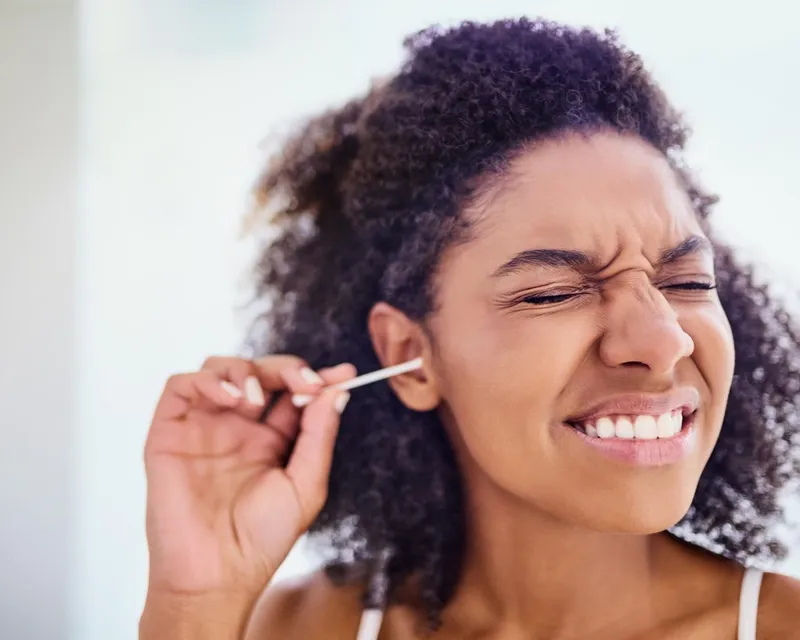
- Cotton buds. The biggest culprit. You wipe away a little earwax and push the rest deeper, where it gets compressed into a hard plug. You can also damage the delicate skin of your ear canal or your eardrum, and cotton fibres are sometimes left behind.
- Ear candles. There is no evidence that they work, and you risk burns or candle wax in your ear canal.
- Sharp objects. Hairpins, paper clips, fingers with long nails: anything you put into your ear canal can cause damage.
- Hard spraying or harsh products. A full-pressure jet of water, soap or alcohol in your ear can hurt or irritate the skin. Rinsing gently with a bulb syringe and lukewarm water is fine, except if you have grommets or a hole in your eardrum.
How to recognise too much earwax
In some people the natural flow stalls, for example because of a narrow or curved ear canal, a lot of small hairs, getting older, or wearing earplugs or a hearing aid. The symptoms then usually build up slowly:
- muffled hearing, as if there is cotton wool in your ear
- a full or pressured feeling, or an ear that is blocked
- itching in the ear canal
- ringing or a beep in your ear
- sometimes mild dizziness
How such a plug forms and what to do when it falls out is explained in our article on earwax blockage. A blocked ear can also be caused by a cold or a pressure difference; you will find those causes in blocked ear.
Removing earwax yourself: how to do it safely
In many cases your ear will sort it out itself if you give it a little help. The steps below follow Thuisarts, the Dutch patient website of the Dutch College of General Practitioners. The American ENT guideline on earwax (AAO-HNS, 2017) also names water or saline as a softener. Your own doctor can advise you on the rules and options in your country.
- 1Soften the earwax with lukewarm water or olive oil. Once a day for 5 days, let lukewarm water run slowly into your ear from the shower head for 3 seconds, with the blocked ear facing up. Or put 5 drops of lukewarm water into your ear twice a day for 5 days and stay in that position for 2 minutes. Or use olive oil: put a few drops into your ear canal 2 to 3 times a day. According to Dutch ENT doctor Dr Jan Rombout, this usually softens the earwax faster.
- 2Skip the pharmacy drops. According to the Dutch GP guidance, ear drops from the pharmacy are not needed: there is not enough research showing that they help.
- 3Ear often blocked? Use a bulb syringe. Fill an ear bulb syringe with lukewarm water, place the tip carefully at the entrance of your ear and squeeze the bulb gently.
- 4Give it time. Softened earwax often moves out by itself within a few days. A warm shower helps.
- 5Still blocked after 5 days? Then see your GP or have the earwax removed.
Please note: hole in your eardrum or grommets
Do you have ear pain, grommets or a (suspected) hole in your eardrum? Then do not put drops in your ear or rinse it yourself. The water could get past the eardrum into your middle ear. Make an appointment with your GP first.
Is your ear suddenly completely blocked? Then it is probably a plug
An ear that slowly becomes more muffled is usually earwax building up. If your ear blocks completely from one moment to the next, often after a shower or a swim, the earwax has probably absorbed water and swollen into a plug that closes off the ear canal.
In that case, too, start with 5 days of lukewarm water. If your ear is still blocked afterwards, the plug usually needs to be removed. Above all, stop poking around: anything you put in your ear pushes the plug deeper.
When should you have earwax removed?
Putting in drops yourself has its limits. Have the earwax removed if:
- your symptoms have not gone after 5 days of lukewarm water
- plugs keep coming back
- you wear a hearing aid or custom earplugs and notice that your ear blocks more quickly
- you would rather not rinse your ear yourself, or want to get rid of the symptoms quickly
Have you suddenly lost your hearing, do you have severe pain with fever, is fluid or pus coming from your ear, or do you feel dizzy? Then earwax removal is not the answer: call your GP straight away (out of hours: the out-of-hours doctor service, or 112 in an emergency).
Microsuction or ear irrigation: what is the difference?
If you want your ears cleaned professionally, you will come across two methods. The difference lies in visibility and technique.
Ear irrigation · the classic method
The ear canal is flushed with lukewarm water until the earwax comes out, usually at the GP's surgery. It often works, but the person treating you cannot see inside the ear canal during the flushing (only before and after). The water pressure can feel unpleasant, and the method is not suitable if you have grommets or have (had) a hole in your eardrum.
Microsuction
The earwax is removed dry with a small medical suction device, while the ear canal stays in view the whole time. No water pressure is involved, and it is also a good solution when irrigation is not possible or has not worked.
How does microsuction work at Audinc?
At Audinc, microsuction is carried out by trained staff working under the supervision of ENT doctor Dr Jan Rombout. We offer it at our locations in the Netherlands. The treatment has three steps:
- 1First we examine your ear canal with an otoscope and assess whether earwax needs to be removed.
- 2Then we carefully remove the earwax with a small medical suction device, using a curette where needed.
- 3The treatment is painless and takes 20 to 30 minutes on average. You can usually hear clearly again straight away.
You do not need a GP referral: you book an earwax removal appointment online and can often come in within a few days.
Tip
Booked an earwax removal appointment? Then put olive oil in your ears 2 to 3 times a day for the three days before. Soft earwax can be removed faster and more comfortably. Do not do this if you have ear pain, grommets or a hole in your eardrum.
Cleaning your ears with earplugs, a hearing aid and before a fitting
If you wear a hearing aid or custom earplugs, earwax deserves extra attention. Your ear canal is closed off for much of the day, so the natural flow stalls. At the same time, earwax clogs the speaker of a hearing aid and the filters of your earplugs, so attenuation or sound gets noticeably worse. If you build up earwax quickly, a check every 6 to 12 months is a good idea.
Getting fitted for earplugs? Then do not poke around in or rinse your ears beforehand. At the appointment we look into your ears first, and usually the impression can be taken straight away. If there is a plug or a lot of earwax, it has to be removed first, because an impression is only accurate in a clear ear canal. Do you know that you build up earwax quickly? Then book earwax removal and the fitting in the same appointment at one of our Dutch locations. The same goes for a hearing test: it is more reliable in a clean ear canal.
How much does earwax removal cost?
- You pay the €25 examination fee online when you book (iDEAL, credit card or Apple Pay)
- Microsuction costs €27.50 per treated ear, paid at the location by debit or credit card
- Both ears? Then it comes to €80 in total
- If we find no earwax, you only pay the examination fee
- Cancel or reschedule free of charge up to 24 hours before your appointment
Got a question? We're all ears.
Frequently Asked Questions
Read MoreFAQ
Usually not. Your ears clean themselves: chewing and talking move old earwax outwards on their own. Only wash the outside of your ear and the entrance of the ear canal with a flannel. Leave the ear canal itself alone.
Wash your outer ear and the area behind it with a damp flannel and wipe away any visible earwax at the entrance. Dry the outside of your ears well after a shower or a swim. That is all you need to do. If your ear is blocked, soften the earwax with lukewarm water.
Once a day for 5 days, let lukewarm water from the shower head run into your ear for 3 seconds, or put 5 drops of lukewarm water in your ear twice a day for 5 days. Olive oil also works; according to Dutch ENT doctor Dr Jan Rombout, it is usually faster. The earwax softens and comes out by itself. Ear drops from the pharmacy are not needed. This is Dutch GP guidance; your own doctor can advise you on the options in your country. Do not do this if you have ear pain, grommets or a hole in your eardrum.
With ear irrigation (syringing), your ear is flushed with lukewarm water. The person treating you looks into your ear before and after, but not during the flushing. With microsuction, the earwax is removed dry with a small medical suction device while the ear canal stays in view the whole time. Microsuction is also an option when irrigation is not possible or has not worked.
No, do not poke around in your ears beforehand. At the appointment we look into your ears first. Usually the impression can be taken straight away. If there is a plug or a lot of earwax, it has to be removed first to get an accurate impression. Do you build up earwax quickly? Then book earwax removal and the fitting in the same appointment, at one of our Dutch locations.
You pay a €25 examination fee online when you book. Microsuction then costs €27.50 per treated ear, paid at the location. For both ears that comes to €80 in total. If we find no earwax, you only pay the examination fee. We offer earwax removal at our locations in the Netherlands.