



Advice based on our own product information and knowledge base, not medical advice.
Hearing Protection in Childcare: Earplugs for Childcare Workers

Screaming, echo and a full group: childcare workers are at risk of hearing damage too. Find out how loud it gets in the group, what your employer must do and which earplugs work if you still want to hear the children.
Take the next step for your hearing
When you think of hearing damage at work, a daycare centre is probably not the first place that comes to mind. Yet the Dutch government’s working conditions portal, Arboportaal, for example, lists daycare centres alongside swimming pools and gyms as places where harmful noise sometimes occurs. Crying babies, screaming toddlers, building blocks on a hard floor and a room that echoes: by the end of the day, you can still hear it.
In this article you’ll find out how loud it can get in the group, what your employer must do and which hearing protection works if you still want to hear the children.
In short
- In the group, the noise averages around 70 dB(A), with loud peaks during screaming, crying and free play. The more children, the louder it gets.
- From 80 dB(A) over the working day, the employer makes hearing protection available. From 85 dB(A), wearing it is mandatory.
- Start with the noise itself: less echo, quieter toys and set times for letting off steam.
- A flat filter makes everything quieter, but you can still hear the children and your colleagues.
On-site fittings · from 3 people we come to your childcare centre, with advice per group and volume pricing for your team.
Request a quoteHow loud is it in childcare?
In a Swedish study, 101 staff at 17 preschools wore a noise meter on their body. On average, they came out at almost 71 dB(A). That is below the legal limit of 80 dB(A), but the noise varied widely and was louder the more children there were in the group. The staff’s hearing at the frequencies tested was worse than that of a comparison group without noise at work, and about 31% had tinnitus. They found the children’s voices the most disturbing (Sjödin et al., 2012).
So the average doesn’t tell the whole story. A child screaming right next to your ear, a group of toddlers in an echoing room or a busy afternoon at after-school care: at moments like these, the noise goes far above that average. How loud it is where you work depends on the group size, the room and the age of the children.
A quick check from the noise checklist by Kinderopvang Werkt, the working conditions platform of the Dutch childcare sector: do you have to raise your voice to understand a colleague one metre away? That is a sign the noise may be harmful, and it’s time to find out exactly how loud it is.
Please note
Hearing damage from noise develops gradually and cannot be repaired. If you notice a ringing, a muffled feeling or difficulty following conversations in a busy room after a working day, take it seriously. If you suddenly hear much worse, call your GP straight away (out of hours: the out-of-hours doctor service, or 112 in an emergency).
Below you can see how long you can safely work at a given sound level. Every 3 dB more halves the safe exposure time.
Calculator · noise dose
How long is this sound safe for your ears?
Pick a situation or set the sound level and duration yourself.
100% is your full daily dose and 3× means three times as much. Above 100%, you risk permanent hearing damage.
Daily exposure: 80 dB(A)
From 80 dB(A): your employer must make hearing protection available and give information and training.
Even with an SNR 19 filter, the level in your ear stays above the 87 dB(A) exposure limit: choose stronger attenuation.
Have the noise measuredEstimate based on 80 dB(A) for 8 hours, where every 3 dB more halves the safe time. These are the EU minimum rules; national rules can be stricter. SNR is a lab value: how much you really block depends on how well your earplug seals. No substitute for a measurement.
What must your employer do?
The rules on noise at work apply in childcare too. In the risk assessment, the employer must check whether noise is a risk. If the noise can go above 80 dB(A), it must be assessed and measured where necessary.
- From 80 dB(A) the employer makes suitable, well-fitting hearing protection available and provides information on the risks.
- From 85 dB(A) wearing it is mandatory, the employer draws up a plan to reduce the noise and you are entitled to a hearing test.
- 87 dB(A) is the limit value in the ear, with the hearing protection in. The noise must never go above that.
These are the EU minimum rules (Directive 2003/10/EC, Articles 3, 6 and 10). Every EU country has written them into its own law, and some countries are stricter, so check your national rules. Employees or their representatives, such as a works council, must be consulted on the measures and on the choice of hearing protection (Article 9).
If the noise stays below 80 dB(A), the EU rules do not require hearing protection. It can still be pleasant to wear, for example if a day in the din wears you out or if you already have tinnitus. Read more about the rules, such as who pays for what, in when is hearing protection mandatory.
The noise itself first: what helps in the group?
The law says so too: tackle the noise first, and only then turn to hearing protection. In childcare, there is a lot to gain in the room and in the daily routine. The Kinderopvang Werkt checklist mentions, among other things:
- Less echo. A reverberation time of 0.5 to 0.7 seconds is ideal; more than 1 second is too much. Sound-absorbing material on the ceiling, on the walls and under the tables helps.
- Quieter toys. Replace noisy toys and put down rugs where children play with hard toys.
- A rhythm to the day. Plan times when children can let off steam, preferably outside or in a room suited to it, and times when it is calm.
- Set a good example. Speak calmly and not too loudly, and let a child come to you when they want to tell you something.
- Noise from outside the group. Sliding walls between groups block little sound. Turn the radio down and don't make phone calls in the group room.
That makes a real difference, but a group of toddlers is still a group of toddlers. Hearing protection is then an addition, especially at the busiest moments of the day.
Can you still hear the children with earplugs?
That is the biggest concern, and rightly so: you don’t want to miss a child speaking softly or a baby waking up. An earplug that shuts everything out is therefore not a good idea in childcare. Disposable foam earplugs often attenuate more than needed, and mostly the high tones, so voices sound muffled.
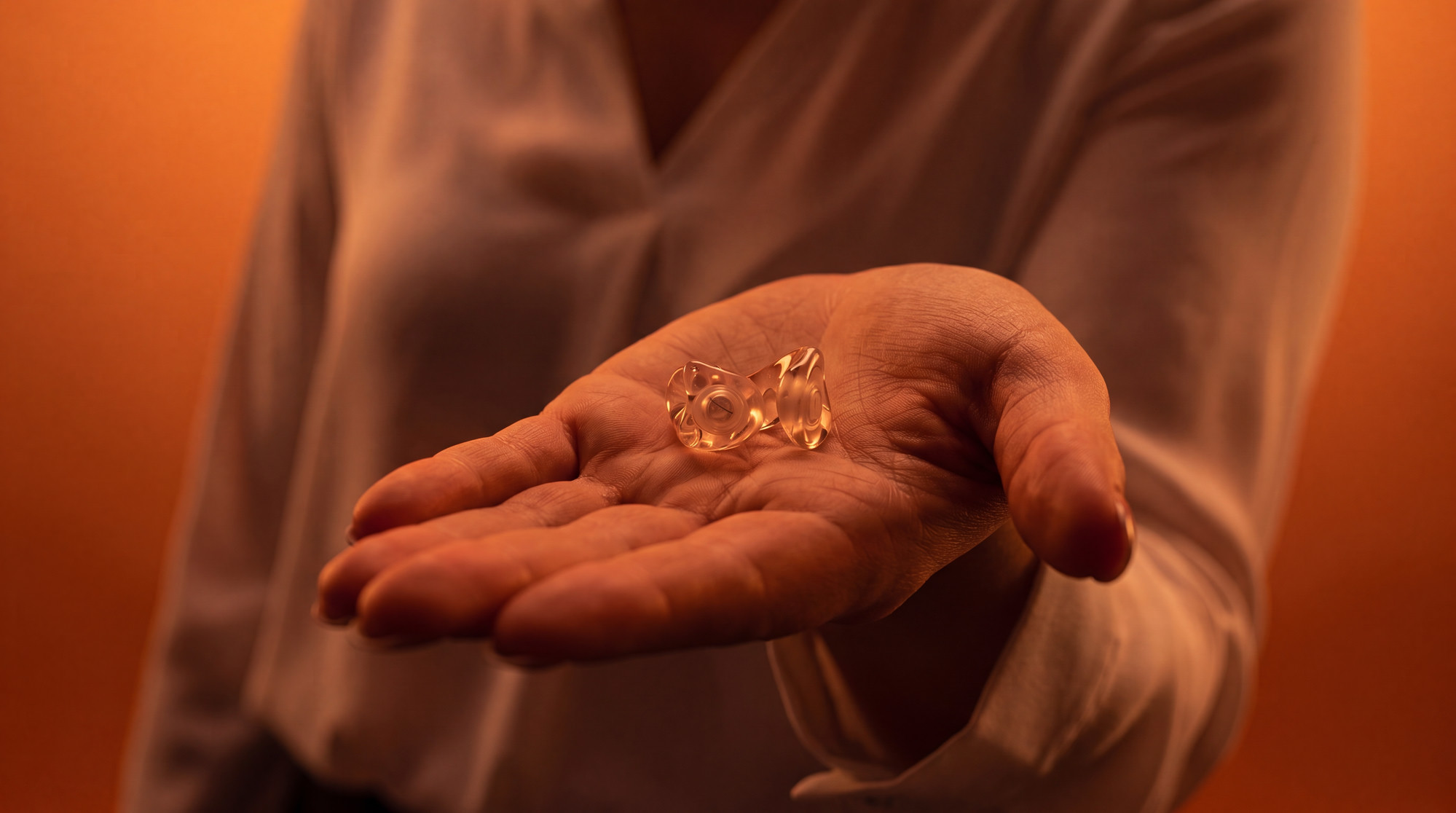
With a light filter that attenuates fairly evenly, you can hear the children. The Pure Tones Work attenuates low, mid and high tones almost equally. Voices sound natural, just quieter, while the screaming and the echo come in less loudly.
In the group
With the medium filter (SNR 16 dB) you take the sharpness off screaming and echo, and you can still understand the group and your colleagues well. For hearing protection at work, this is the lightest filter: the very lightest one (SNR 10 dB) falls below the threshold for CE certification.
Busy group or sports hall
If you work in a large, echoing room or take the after-school group to the gym, a stronger filter (SNR 19 or 23 dB) may be more comfortable. With the Click filter you temporarily click it shut to SNR 28 dB.
Not sure which filter suits you? In the first 3 months after delivery, you can exchange it free of charge for a lighter or stronger one. The Pure Tones Work is made of soft silicone with an anti-allergenic coating and stays comfortable even after a full working day. Individual price: €131.40 per person excl. VAT; for groups we work with volume pricing.
Two practical tips. After use, keep your earplugs in their case and out of the children’s reach, because they are small parts. And clean them regularly with lukewarm water; you can read how in how to clean earplugs.
Do you get overstimulated by sound easily yourself? Then earplugs help outside work too. Take a look at our page on earplugs for sensory overload.
On-site fittings
From 3 people we come to your childcare centre to take impressions; contact us for on-site fittings in your country. We take an ear impression of each employee and advise which filter suits each group. We then make the earplugs in 15 working days. On delivery, we use an audio test to measure how much the earplugs actually attenuate for each employee.
Want to know how loud it really is first? With a sound measurement we map the noise per group. We can combine that with on-site hearing tests and a toolbox session in which the team learns why and how to protect their hearing. For one or two people, you can visit one of our locations: book a free fitting. Not near one of our locations? Have impressions taken locally and send them to us.
You have a 6-month comfort guarantee: if the earplugs are not comfortable, we adjust them. You can see all the options for work on hearing protection for work.
Do you work in education? Then read our article on hearing protection for teachers and PE teachers. In our overview of jobs with a high risk of hearing damage you can see how childcare compares with other sectors.
On-site fittings · from 3 peopleHearing protection for your teamTell us how many employees and which location it concerns. You'll get a quote with advice per group and volume pricing. Request a quoteSources
- Directive 2003/10/EC on noise at work: EUR-Lex, Articles 3, 6, 9 and 10
- Arboportaal, Dutch government (in Dutch): Noise
- Kinderopvang Werkt (in Dutch): Checklist on noise nuisance in childcare (pdf)
- Sjödin F. et al. (2012): Noise exposure and auditory effects on preschool personnel, Noise & Health 14(57), 72–82
Got a question? We're all ears.
Frequently Asked Questions
Read MoreFAQ
That depends on the noise over the working day. If it goes above 80 dB(A), the employer must provide suitable hearing protection and information. From 85 dB(A), wearing it is mandatory. With the protection in, the noise in the ear must not go above 87 dB(A). These are the EU minimum rules (Directive 2003/10/EC), and some countries are stricter. A sound measurement shows whether your group reaches those levels.
Yes, if you choose a light filter with fairly flat attenuation. A filter like that makes low, mid and high tones almost equally quieter. Voices sound natural, just less loud, and you can still understand the children and your colleagues. The screaming and the echo come in less loudly.
In a Swedish study of 101 staff at 17 preschools, average exposure was around 71 dB(A), with large peaks. The more children in the group, the louder it was. About 31% of the staff had tinnitus. How loud it is where you work depends on the group size, the room and the age of the children.
Custom earplugs with a flat filter, such as the Pure Tones Work. With the medium filter (SNR 16 dB) you take the sharpness off screaming and echo and can still follow the group well. If the filter does not suit you, you can exchange it free of charge for a lighter or stronger one in the first 3 months.
Yes. From 3 people we come to your location to take ear impressions; contact us for on-site fittings in your country. We then make the earplugs in 15 working days. For smaller numbers, you can visit one of our locations. You have a 6-month comfort guarantee: if the earplugs are not comfortable, we adjust them.