





Ear Pain and Pressure When Flying: What Helps, and What Do Earplugs Do?

Ear pain or a blocked ear during the descent? Find out what happens in your ear, what you can do yourself, what to watch out for with children or a cold, when to see your GP and what flight earplugs can and cannot do.
Take the next step for your hearing
The plane starts its descent, and there it is again: a pressing feeling in your ear, as if something is stuck in it. For some people it stays at that, for others it turns into a stabbing pain that only slowly fades after landing. Ear pain from pressure changes is common, especially during the descent and when you have a cold. In this article you will read what happens in your ear, what you can do yourself, what to watch out for with children or a cold, when to see your GP, and what earplugs can and cannot do. Including against the noise in the cabin, if you want to sleep.
In short
- Ear pain when flying develops in your middle ear, when the pressure behind your eardrum does not keep up with the cabin pressure. This goes wrong most often during the descent.
- Swallowing, chewing, yawning and gently popping your ears help to equalise the pressure. Let young children drink during the descent.
- Got a cold or an ear infection? Then the chance of pain is higher. Talk to your GP before the trip.
- An earplug with a pressure filter can smooth out the pressure change, but it is no guarantee against ear pain. It does reduce the cabin noise of typically around 83 dB.
What happens in your ear during the climb and descent?
Behind your eardrum is the middle ear, a small space filled with air. Through the Eustachian tube, that space is connected to the back of your nose and throat. Every time you swallow or yawn, that tube opens for a moment and the pressure on both sides of your eardrum becomes equal. How that works together with the rest of your ear is explained in how does hearing work.
On a plane, the air pressure in the cabin changes. During the climb the pressure drops, and air escapes from your middle ear. That usually happens by itself; at most you feel a little pop. During the descent the cabin pressure rises again and a negative pressure builds up in your middle ear. Air then has to flow in, and that is harder. That is why most people mainly have trouble during the landing.
If equalising does not work well, your eardrum is sucked inwards. That causes a blocked feeling, muffled hearing and sometimes quite a lot of pain. The medical name is barotitis, or barotrauma if damage occurs. It usually clears up by itself. Other causes of a blocked ear, such as earwax or water, are covered in blocked ear.
How to help your ears during the descent
- 1Swallow, chew and yawn. This opens the Eustachian tube. Dutch GP guidance (Thuisarts) advises chewing or swallowing a few times during the descent. Chewing gum, a sweet or a sip of water helps.
- 2Pop your ears gently. Pinch your nose, keep your mouth closed and blow out gently until you feel a little click. Never blow hard: you can damage your eardrum that way.
- 3Be awake when the descent begins. When you sleep, you swallow less and only notice the pressure once it has built up a lot. Start swallowing and popping your ears as soon as you notice the first feeling of pressure, not only when it hurts.
- 4Popping does not work? Try a nasal balloon. You inflate a small balloon with your nose, which opens the Eustachian tube. Children can usually do this from about the age of three.
- 5Consider an earplug with a pressure filter. It can slow down the pressure change at your eardrum, giving you more time to equalise. What such a filter can and cannot do is explained below.
Flying with children
Children are affected by pressure changes more often than adults. According to the Belgian self-care guideline from Gezondheid en Wetenschap, about a quarter of children get symptoms, compared with 5 to 15 percent of adults. You can let young children drink during the landing: swallowing opens the Eustachian tube. Older children can chew, suck a sweet or learn to pop their ears gently.
Does your child have an ear infection, grommets or recent ear surgery? Then talk to your GP or an ENT doctor (ear, nose and throat doctor) before the trip. Dutch GP guidance warns that flying with a middle ear infection can be very painful. In those cases, do not use earplugs either.
Flying with a cold
A cold makes the lining of your nose and Eustachian tube thicker. As a result, the tube opens less easily, and the pressure in your middle ear cannot adjust properly. Dutch GP guidance explains that a cold can also give you ear pain or ringing in your ears. During the descent you notice it first.
The Belgian self-care guideline advises avoiding flying as far as possible if you have a respiratory infection, sinusitis or a middle ear infection. If the trip cannot wait, ask your GP or pharmacist for advice. Nose drops or nasal spray with xylometazoline can temporarily open a blocked nose a little; Dutch GP guidance says to use them no more than 3 times a day and for no longer than a week, because after that they work less and less well. There is no proof that they prevent ear pain. Your own doctor can advise you on the rules and options in your country.
When should you call your GP?
Watch out
Call your GP straight away (out of hours: the out-of-hours doctor service, or 112 in an emergency) if you have a blocked ear with severe pain and a fever, if you feel unwell or if you suddenly cannot hear with one or both ears. Also call if you have pain after flying, if fluid or blood comes out of your ear, or if you become dizzy, get ringing in your ears or hear worse.
Make an appointment on a working day if your ear is still blocked after a few days, even if you have followed the advice. Dutch GP guidance gives a period of 5 days. Have you had a barotrauma? Then wait to fly or dive until your ear has healed; the Belgian guideline advises against it for the first 10 days. Your own doctor can advise you on the rules and options in your country.
What do earplugs do against pressure changes?
To be honest: less than some packaging promises. The pain during the descent develops in your middle ear, behind your eardrum, and is resolved through the Eustachian tube. No earplug reaches that far. An ordinary earplug or a foam plug also simply lets the pressure change through.
An earplug with a pressure filter works differently. Such a filter lets air through only very slowly. As a result, the pressure between the earplug and your eardrum rises more slowly than in the cabin, and your Eustachian tube gets more time to equalise the pressure in small steps. Many travellers notice less pressure as a result. But there is little independent research on it, and the Belgian self-care guideline does not recommend earplugs as a remedy for pressure problems. So see a pressure filter as an aid, alongside swallowing and popping your ears, and not as a solution that prevents ear pain.
What a pressure filter does
Slow down the pressure change at your eardrum, so equalising becomes easier. And reduce the engine and turbine noise in the cabin, so you travel more calmly and sleep more easily.
What it does not do
Open your Eustachian tube. Clear a blocked nose, a cold or an ear infection. Or prevent ear pain for everyone. Do not use earplugs if you have an ear infection, grommets, a hole in your eardrum or shortly after ear surgery.
Cabin noise and sleeping on a plane
Besides the pressure, there is the noise. In an American study, the noise was measured on 200 flights. The noise level was typically around 83.5 dB(A), with large differences per aircraft and per seat: close to the engines it is louder. That does not hurt, but it lasts for hours. If you get off a long flight tired and with a dull head, that constant drone is partly to blame.
83.5 dB(A)
typical noise level in the cabin, measured on 200 flights.
± 4 hours
safe time at 83 dB according to the rule of thumb of 80 dB(A) for 8 hours.
10+ hours
is easily how long a flight to Asia or America takes.
The rule of thumb is meant for daily noise, for example at work. One long flight a year is something different for your hearing than one every week. But for cabin crew, pilots and anyone who flies a lot for work, it adds up. At work, the EU minimum rules (Directive 2003/10/EC) require employers to offer hearing protection from 80 dB(A) over an 8-hour day. Every EU country has written them into its own law, and some countries are stricter, so check your national rules. Work out for yourself what a long flight does to your ears:
Calculator · noise dose
How long is this sound safe for your ears?
Pick a situation or set the sound level and duration yourself.
100% is your full daily dose and 3× means three times as much. Above 100%, you risk permanent hearing damage.
Estimate based on 80 dB(A) for 8 hours, where every 3 dB more halves the safe time. These are the EU minimum rules; national rules can be stricter. SNR is a lab value: how much you really block depends on how well your earplug seals. No substitute for a measurement.
If you mainly want to sleep, any well-sealing earplug helps. A custom one also stays comfortable when you lean your head against the window or the headrest. Put your earplugs in before you fall asleep, so they are already in place when the plane starts to descend. Why earplugs also help in a hotel or at a campsite is explained in earplugs against snoring. How loud everyday sounds are can be found in how many decibels is harmful.
Which flight earplug suits you?
| Product | Pressure regulation | Attenuation | Price |
|---|---|---|---|
| Custom Audinc Fly | Metal pressure tube | SNR 29 dB | €169.95 |
| Custom Pure Tones Flying | Membrane in a linear filter | SNR 10–23 dB (Click 28) | €159.95 |
| Custom SleepzZ | None | Maximum, without a filter | €119.95 |
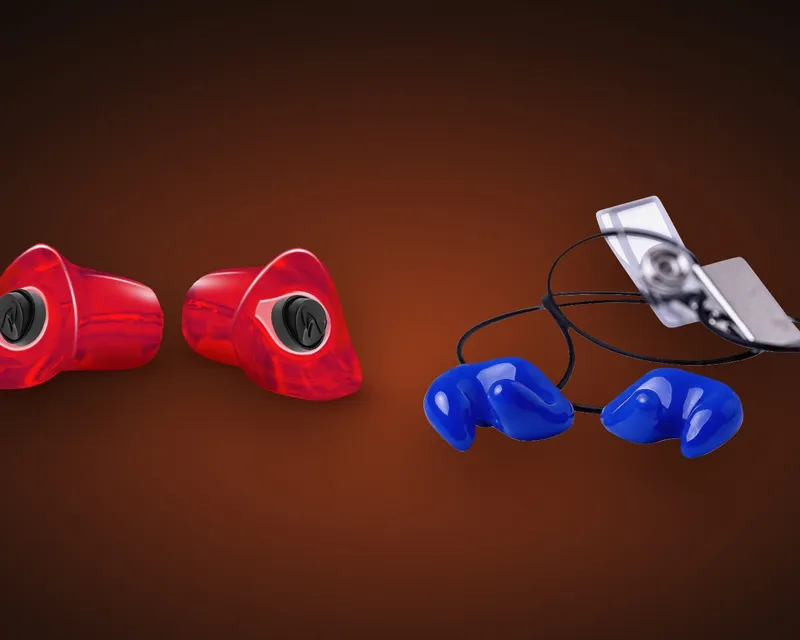
Custom Audinc Fly: built around pressure
The Custom Audinc Fly has a metal tube halfway along the canal of the earplug, with a 0.3-millimetre opening on the outside. Through that small opening, the pressure change reaches your eardrum with a delay. According to the calculation by the filter’s manufacturer, the pressure rise during the descent is stretched from about 25 to 40 minutes. The Fly also reduces engine and turbine noise with SNR 29 dB, while conversations and announcements stay easy to understand.
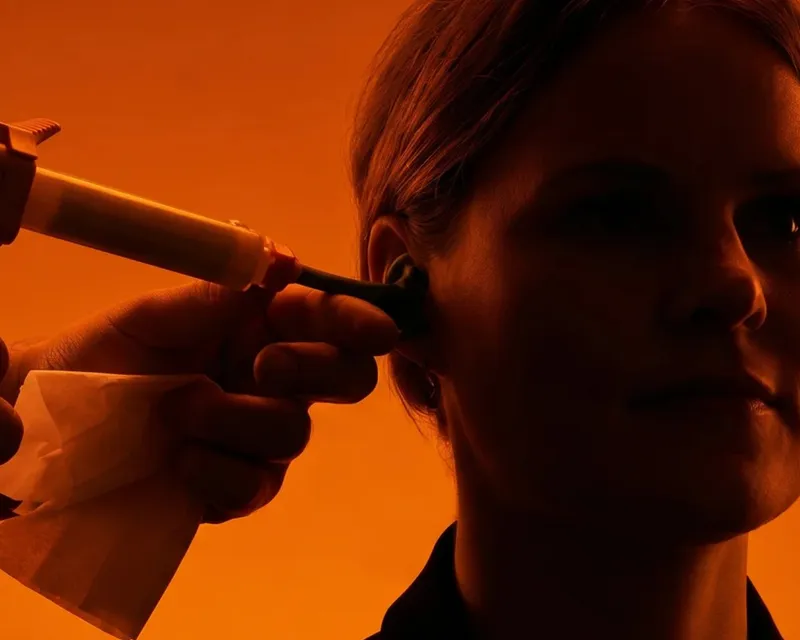
Put the Fly in about 45 minutes before landing, so well before the plane starts to descend, and leave it in until you are on the ground. If you also have trouble during take-off, put it in before departure. Only a plug that seals completely can regulate the pressure. That is why we make it from an impression of your ear, in soft silicone.
Custom Pure Tones Flying: mainly quiet
The Custom Pure Tones Flying is first and foremost a noise reducer. The linear filter reduces low, mid and high tones by roughly the same amount, so the engine noise fades away while voices and flight information still sound natural. The filter contains a membrane that lets a pressure change through more slowly. You choose the strength from SNR 10 to 23 dB, and with the optional Click upgrade you switch to SNR 28 dB.
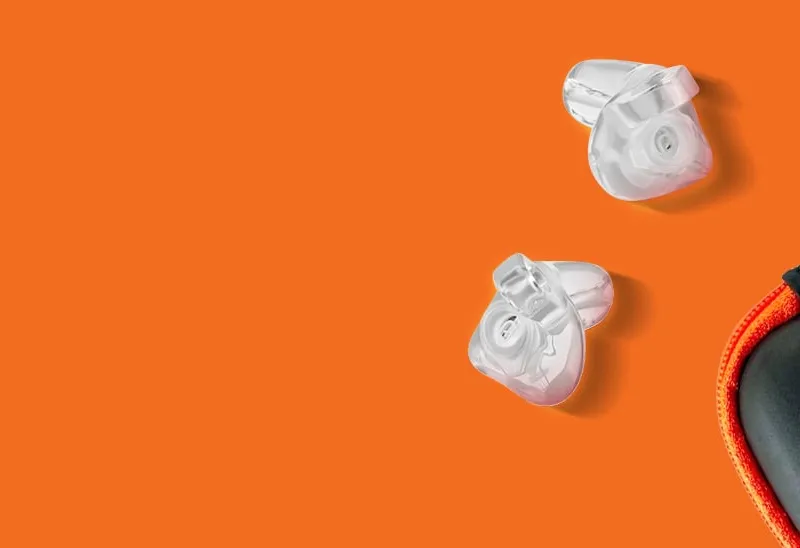
Custom SleepzZ: just sleeping
Just want to sleep, on the plane and at home? The Custom SleepzZ has no filter and seals as quietly as possible. It does nothing about the pressure, so if your ears bother you during the descent, one of the other two is a better fit.
We make all three in our own 3D lab in Eindhoven, the Netherlands. The production time is 15 working days, and rush orders are possible. You get at least 2 years’ warranty on the material and a 6-month comfort guarantee. On the page earplugs for flying you can compare them side by side.
For pilots: Bose ProFlight sleeves and Custom Headset
In the cockpit you usually wear a headset. If you fly with a Bose ProFlight Series 2, we replace the standard ear tips with Custom Sleeves made to fit your ear, for €149.00. They seal better, so the noise cancelling does what it is supposed to do, and they do not press on long flights. Everything about the price, the fitting and other models is in custom-made Bose ProFlight sleeves.
Looking for a complete custom headset with a microphone? The Custom Headset costs €219.00 and has a 3.5 mm mini-jack. It does not fall out and stays in place even with intensive use. Whether it connects to your set-up differs per aircraft and system, so get in touch with us first.
Earplugs for flyingQuieter flights, with less pressureCustom-made, with a pressure filter or a linear filter. Ready in 15 working days. View flight earplugsSources
- Thuisarts.nl (Dutch GP guidance, by the Dutch College of General Practitioners): I have a perforated eardrum (in Dutch; chewing or swallowing during the descent; when to call after flying)
- Thuisarts.nl: I have a blocked ear (in Dutch; when to call your GP)
- Thuisarts.nl: I have a cold (in Dutch; ear pain and ringing in the ears with a cold, use of xylometazoline)
- Thuisarts.nl: My child has a middle ear infection (in Dutch; flying with a middle ear infection)
- Gezondheid en Wetenschap (Belgium): Ear conditions caused by changing air pressure (barotitis and barotrauma) (in Dutch; 2020; symptoms more frequent during descent, children, flying with a cold, nasal balloon, earplugs not recommended)
- Zevitas, C.D. et al. (2018): Assessment of noise in the airplane cabin environment, Journal of Exposure Science & Environmental Epidemiology

Got a question? We're all ears.
Frequently Asked Questions
Read MoreFAQ
During the descent, the air pressure in the cabin rises. Your middle ear has to keep up with that pressure through the Eustachian tube, the small tube between your middle ear and the back of your nose and throat. During the descent, air flows in through that tube less easily than it flows out during the climb. If it does not happen fast enough, your eardrum is pushed inwards. That feels like a blocked ear and can be quite painful.
An ordinary earplug does not: it simply lets the pressure change through. An earplug with a pressure filter can slow down the pressure change at your eardrum, giving your body more time to equalise. Many travellers notice less pressure, but it is not a guarantee. The pain develops in your middle ear, and no earplug reaches that far. Do not use earplugs if you have an ear infection, grommets or a hole in your eardrum.
With a cold, the chance of ear pain during the descent is higher, because the Eustachian tube can become blocked. A Belgian self-care guideline advises avoiding flying as far as possible if you have a respiratory infection, sinusitis or a middle ear infection. According to Dutch GP guidance, flying with a middle ear infection can be very painful. If you have to fly anyway, talk to your GP or pharmacist beforehand.
A blocked ear from a pressure change usually clears within a few hours. Call your GP straight away (out of hours: the out-of-hours doctor service, or 112 in an emergency) if you have severe pain and a fever, feel unwell or suddenly cannot hear. Also call your GP if you have pain, fluid or blood from your ear, dizziness, ringing in your ears or worse hearing after the flight. Is your ear still blocked after a few days? Then make an appointment.
Let young children drink during the descent: swallowing opens the Eustachian tube. Older children can chew, swallow or suck a sweet. Children are affected more often than adults. If your child has an ear infection, grommets or has just had a cold, talk to your GP before the trip.
In a study on 200 flights, the noise level in the cabin was typically around 83.5 dB(A), and higher closer to the engines. That does not hurt, but it lasts for hours. That is why you often arrive tired after a long flight. With earplugs the cabin becomes quieter and you sleep more easily.