







Advice based on our own product information and knowledge base, not medical advice.
How to Prevent Tinnitus: Protect Your Ears (and Which Earplugs Work)
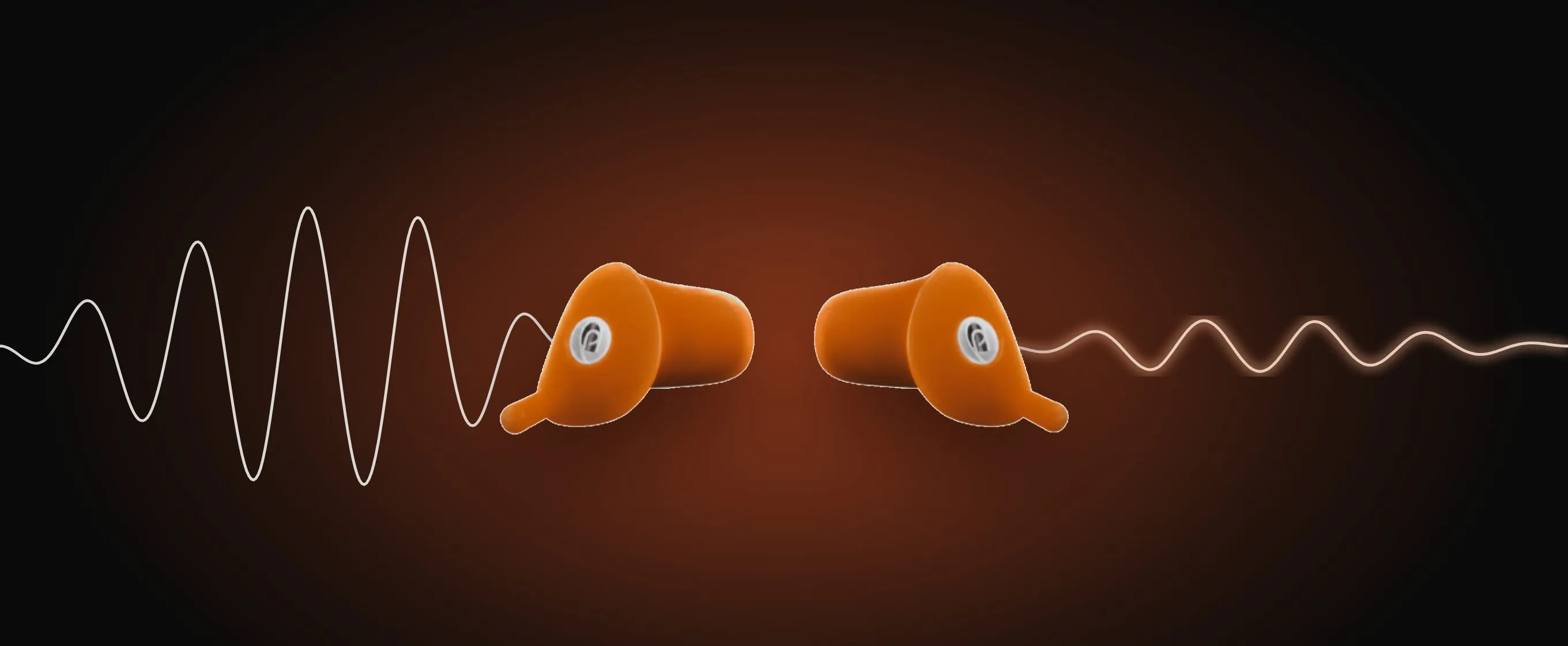
Noise-induced tinnitus cannot be repaired, but it can be prevented. Find out how long loud sound is safe, what you can do yourself and which earplugs really protect your ears.
Take the next step for your hearing
You walk out of a concert and there it is: a high-pitched ringing, or a hiss you did not hear all evening. By the next morning it is usually gone. Even so, that sound is not a harmless side effect of a good night out. It is a sign that your ears have had too much.
Tinnitus means hearing a sound that is not there: ringing, hissing, buzzing or humming. What tinnitus is exactly and what causes it is explained on our tinnitus page. This article is about what you can do before it gets that far. Noise is the cause you have most control over, and it is common: in the Netherlands, for example, one in five students at vocational schools has at some point had ringing or hissing in their ears after listening with earbuds or headphones (VeiligheidNL, the Dutch safety institute).
In short
- Noise damage in your inner ear does not heal. That is why prevention is the only thing that really works.
- Rule of thumb: 80 dB(A) for 8 hours, and every 3 dB louder halves the time. At 100 dB you reach your daily dose after about 5 minutes.
- Earplugs prevent new damage. They do not cure existing tinnitus.
- How well an earplug seals determines how much attenuation you really get. That is where foam, universal earplugs and custom-made ones differ most.
- Wear hearing protection in loud sound, not in silence.
Why prevention is the only real solution
Deep inside your ear, in the cochlea, hair cells turn sound into signals for your brain. Sound that is too loud or lasts too long damages those hair cells and the nerve connections behind them. They do not grow back. If your brain receives less signal as a result, it can turn up the volume itself, and you hear that as tinnitus. How that works exactly is explained in why tinnitus starts in your brain.
There is no pill or procedure that takes away noise-induced tinnitus. Treatment is mainly about learning to be less bothered by it. That it can happen to anyone is shown by Chris Martin and other famous artists with tinnitus.
The ringing after a night out
The ringing after a party is usually a temporary threshold shift: your ears are overloaded and hear less well for a while. It often recovers within a few hours to a day. That does not mean nothing has happened, though.
In a well-known study in mice (Kujawa and Liberman, 2009), hearing recovered completely after a single loud exposure, while a large share of the nerve connections in the inner ear was lost for good. A standard hearing test does not pick that up, hence the name hidden hearing loss. Whether the same happens in humans has not yet been conclusively shown; researchers find it difficult to measure. The lesson is clear, though: treat the ringing as a warning. The more often you push your ears to that point, the greater the risk of permanent damage and permanent tinnitus.
Note
Do you suddenly hear much worse in one ear, together with ringing? Call your GP straight away (out of hours: the out-of-hours doctor service, or 112 in an emergency). Also make an appointment with your GP if the ringing lasts, is on one side only, pulses with your heartbeat or comes with dizziness, ear pain or headache.
How loud is too loud? Your noise dose
Whether sound causes damage depends on two things: how loud it is and how long you are exposed to it. Together, that is your noise dose. Because decibels are logarithmic, every step counts: 3 dB more means twice as much sound energy reaching your ears, even though it only sounds a little louder.
A widely used, cautious rule of thumb takes 80 dB(A) for 8 hours as a safe daily dose. That is the lower exposure action value in the EU Noise Directive: from 80 dB(A) your employer must make hearing protection available, and from 85 dB(A) you must wear it. These are the EU minimum rules (Directive 2003/10/EC). Every EU country has written them into its own law, and some countries are stricter, so check your national rules. Every 3 dB more halves the safe exposure time: 83 dB is 4 hours, 86 dB 2 hours, 89 dB 1 hour, 95 dB a quarter of an hour. At 100 dB you end up at about 5 minutes, at 103 dB at roughly 2.5 minutes. For comparison: the WHO considers 80 dB safe for up to 40 hours a week.
How loud is it in practice? On an average building site it is around 90 dB(A), and an angle grinder reaches 95 to 105 dB(A) (Volandis, the Dutch construction industry’s health and safety body). On a motorcycle, wind noise under your helmet is the biggest source: measurements come out at around 90 dB(A) at 60 km/h, rising to 110 dB(A) at 160 km/h. In clubs and at concerts the level is often around 100 dB. There is no EU standard for sound at events or in bars and clubs: each country, and sometimes each region or city, sets its own rules. The WHO recommends a maximum of 100 dB averaged over 15 minutes for venues and events. In the Netherlands, for example, the music industry has agreed to a maximum of 103 dB(A) averaged over 15 minutes. Other countries set their own limits, and many have none.
Building site or workshop · ± 90 dB
± 50 min
The average on a building site. With an angle grinder or circular saw you go well above that.
Motorcycle on the motorway · ± 98 dB
± 7 min
Wind noise under your helmet, not your exhaust. The faster you ride, the faster it adds up.
Club · ± 100 dB
± 5 min
A night out easily lasts four to six hours. That is many times your daily dose.
Concert or festival · 103 dB
± 2.5 min
The maximum agreed in the Netherlands, averaged over 15 minutes. Right by the speakers it can be louder.
Safe time without protection, according to the rule of thumb above. These are guide values: the real level varies from place to place, and if you are often in loud sound, damage builds up faster.
Noise dose calculatorHow long is loud sound safe?Choose your situation and see what a filter does. Work it out7 ways to prevent tinnitus
You do not have to stay at home to spare your ears. With these habits you greatly reduce the risk of tinnitus, without having to give up much.
- 1Wear hearing protection as soon as it gets loud. A handy rule of thumb: if you have to raise your voice to be understood by someone a metre away, you are above 80 dB(A). So take your earplugs with you as a matter of course, just like your keys.
- 2Keep your distance from the speakers. A few metres further away quickly makes several decibels of difference, and so many times more safe time. You will find more tips for the dance floor in earplugs for going out.
- 3Take ear breaks. The WHO advises spending about ten minutes every hour in a quiet spot in clubs and at concerts. At a festival that is easy to do; see also our 3 tips for earplugs at festivals.
- 4Turn your headphones down. The WHO advises a maximum of 60% of the volume and regular breaks. Well-fitting or noise-cancelling earbuds help, because you are less tempted to turn the volume up to drown out the noise around you.
- 5Protect your ears at work. Under EU rules, your employer must make hearing protection available above 80 dB(A), and above 85 dB(A) you must wear it. Read when hearing protection is mandatory or take a look at hearing protection for work.
- 6Do not forget the motorcycle. A helmet only reduces wind noise to a limited extent. If you regularly ride on the motorway, you are better off with motorcycle earplugs that sit flat under your helmet. If you listen to music or navigation on the way, read how to do that safely on a motorcycle.
- 7Watch for your warning signs. Ringing, a dull feeling or suddenly struggling to follow conversations: you have had too much. Alcohol and drugs make you less alert to those signals. Not sure how loud something is? Check how many decibels is harmful.
Which earplugs help against tinnitus?
Earplugs against tinnitus do not exist in the sense that they make tinnitus disappear. What they do is reduce the sound that reaches your inner ear, so that no new damage is added. Whether that works depends mainly on two questions. Does the earplug seal your ear canal properly? And do you keep it in all evening?
Foam and universal earplugs
Foam earplugs offer a lot of attenuation on paper, but are often not inserted properly. They then hardly attenuate at all and give a false sense of security; Dutch public health services advise against them at events for that reason. Music sounds dull through them and conversation is difficult. Universal earplugs with a music filter sound better, but come in fixed sizes. If they do not fit exactly, sound leaks past them or they work loose during the evening.
Custom-made with a filter
Made from an impression of your ear, so the ear canal is sealed all the way round. The filter then determines how much is attenuated, and that is also what you get. Because nothing presses, you can easily keep them in for hours. You choose the filter strength that suits your situation.
At Audinc we make two kinds of custom music earplugs. The Custom Music has a non-linear tube filter that attenuates the high tones slightly more, so the sound is a little warmer. In the hard version, the medium filter has an SNR of 19 dB, the strong filter 31 dB and the Ludicrous filter 34 dB; the soft silicone version is slightly lower. The Custom Pure Tones has a flat filter that attenuates low, mid and high tones almost equally, for the most natural sound. Depending on the filter, the SNR is between 10 and 23 dB, and up to 28 dB with the Click upgrade. For a club, choose at least the medium filter (SNR 16): the lightest filter falls below the CE limit for hearing protection.
What does that mean in a club? Take 100 dB and a filter with an SNR of 19: about 81 dB then reaches your eardrum, and by the same rule of thumb you can keep going for well over six hours instead of five minutes. The SNR is a lab value, though; how much attenuation you get in practice depends on how well the earplug fits and how you insert it.
Tip
Do not automatically choose the strongest filter. For a club or concert, a medium filter is often enough. If you play drums, stand right by the speakers or work in a bar or club, a stronger filter makes sense. Too much attenuation mainly means you end up taking them out.
Want to see all the options side by side? Take a look at music earplugs, the festival earplugs or read how custom earplugs are made.
Already have tinnitus? How to stop it getting worse
Even if you already have tinnitus, it pays to protect your ears. Extra noise damage can make the symptoms worse. Dutch GP guidance (Thuisarts, by the Dutch College of General Practitioners) puts it simply: always protect your ears when there is a lot of noise around you. Your own doctor can advise you on the rules and options in your country.
Just do not go too far. Wearing earplugs to avoid normal, everyday sounds actually makes your ears more sensitive, as the Dutch Jeroen Bosch Hospital, among others, warns. On top of that, tinnitus is most noticeable in silence. A soft background sound, such as music at low volume, an open window or a fan, often makes it less noticeable. So wear your earplugs in loud sound, and take them out when it is quiet.
If it bothers you a lot, talk to your GP. In the Netherlands, GPs refer patients to an audiology centre, where support such as cognitive behavioural therapy is available; ask your GP what is available in your country. Earplugs and sound enrichment are not a treatment for tinnitus. Would you first like to know what kind of sound you hear? Take the tinnitus test with real sounds.
Not sure which earplugs suit your situation? During an appointment we take impressions of your ears and look together at which filter suits how and where you will wear them. Not near one of our locations? Have impressions taken locally and send them to us.
Sources
- WHO: Deafness and hearing loss: Safe listening (volume below 60%, 80 dB for 40 hours a week, ear breaks)
- EU: Directive 2003/10/EC on noise at work (hearing protection available from 80 dB(A), worn from 85 dB(A))
- WHO: Global standard for safe listening venues and events (2022; maximum 100 dB averaged over 15 minutes)
- Dutch House of Representatives: Letter on preventing hearing damage, parliamentary paper 32 793 no. 697 (2023, in Dutch; Dutch industry agreement of 103 dB(A) averaged over 15 minutes)
- GHOR and GGD Groningen: Factsheet on preventing hearing damage at events (2025, in Dutch; advice on foam earplugs)
- Volandis: Noise factsheet (in Dutch; sound levels in construction, raised-voice rule of thumb)
- Behar, A.: Motorcycle noise, part II, Canadian Audiologist (wind noise by speed)
- Kujawa, S.G. and Liberman, M.C. (2009): Adding insult to injury: cochlear nerve degeneration after temporary noise-induced hearing loss, Journal of Neuroscience
- Bramhall, N. et al. (2019): The search for noise-induced cochlear synaptopathy in humans: mission impossible?, Hearing Research
- VeiligheidNL: 1 in 5 vocational students has had ringing or hissing in their ears after listening with earbuds (in Dutch)
- Cima, R.F.F. et al. (2019): A multidisciplinary European guideline for tinnitus: diagnostics, assessment, and treatment, HNO
- Thuisarts.nl: Ik heb last van oorsuizen (Dutch GP guidance on tinnitus, in Dutch)
- Jeroen Bosch Hospital: Overgevoelig voor geluid: tips voor het omgaan met hyperacusis (in Dutch)
Got a question? We're all ears.
Frequently Asked Questions
Read MoreFAQ
By not overloading your ears. Spend less time in loud sound, keep your distance from the speakers, take ear breaks and wear hearing protection with a filter as soon as you have to raise your voice to be understood by someone a metre away. Noise is the cause of tinnitus you have most control over. Not every form can be prevented: tinnitus can also be linked to ageing, ear problems or medication.
They help against new noise damage, and that is the most important avoidable cause of tinnitus. They do not cure existing tinnitus. If you already have tinnitus, earplugs in loud sound stop it from getting worse. Do not wear them in silence or for normal everyday sounds: that actually makes your hearing more sensitive.
Earplugs that seal well and that you keep in all evening or all working day. Foam earplugs offer a lot of attenuation on paper, but are often not inserted properly and make music sound dull. Earplugs with a music filter keep the sound clear, and custom-made ones seal most reliably. Take a look at the Custom Music, for example, or our overview of music earplugs.
A widely used rule of thumb: your ears can handle 80 dB(A) for 8 hours, and every 3 dB louder halves that time. At 100 dB, roughly the level in a busy club, you reach your daily dose after about 5 minutes. You will find more examples in our article on how many decibels is harmful.
Headphones or earbuds can cause tinnitus if you listen loudly for a long time: in the EU, phones and music players can produce up to 100 dB(A). The WHO advises keeping the volume below 60% of the maximum and giving your ears regular rest. Hearing protection earplugs do not cause tinnitus. Existing tinnitus is more noticeable, though, if you wear them in a quiet environment.
Related blog articles
Ringing or Hissing in Your Head? How Your Brain Creates Tinnitus
Famous People With Tinnitus: Chris Martin and Other Artists
How Many Decibels Is Harmful? Table With 30–140 dB Examples