





Music, Navigation and Intercom on a Motorcycle: How to Protect Your Hearing

Wind noise under your helmet reaches 100–110 dB. Find out why a helmet does not block enough noise, what the rules for earphones on a motorcycle are in Europe and how to hear music, navigation and your intercom safely.
Take the next step for your hearing
You ride onto the motorway, your sat nav announces a turn and you can barely hear it. So you turn the volume up. Sound familiar? Under a motorcycle helmet it is much louder than most riders think. Most of that noise does not come from your engine, but from the wind. In this article you will read how loud it is under your helmet, why your helmet does little about it, what the rules are for earphones and headsets on a motorcycle in different European countries, and how to hear music, navigation and your intercom without damaging your hearing.
In short
- Wind noise under your helmet is around 90 dB at 60 km/h, rising to 100 dB on the motorway and 110 dB at 160 km/h.
- A helmet only reduces that to a limited extent. If you turn your helmet speakers up above it, you add even more sound.
- The rules differ per country. In the Netherlands, for example, hands-free calling and music are allowed as long as it is safe, but holding a phone is not. In France and Spain, earphones are banned while riding.
- Custom earplugs block the wind. With speakers built in, you hear your music, navigation or intercom at a lower volume.
How loud is it under your helmet?
When you stand still with the engine idling, you mainly hear the engine. As soon as you speed up, the wind takes over. The air flowing past your helmet swirls around the chin bar, the neck and the edges of the visor, and that creates a constant, low roar in your ears.
Measurements by audiologist Alberto Behar come out at around 90 dB(A) at 60 km/h, rising to 110 dB(A) at 160 km/h. At motorway speed you end up in between, at around 100 dB. How loud it is for you depends on your helmet, your bike, your fairing or windscreen and your riding position. But even with a quiet helmet, on the motorway you are well above the level at which hearing damage starts.
60 km/h · ± 90 dB
± 50 min
A ride along a country road. After about 50 minutes you reach your daily dose.
Motorway · ± 100 dB
± 5 min
Just riding on to your destination quickly adds up to many times your daily dose.
160 km/h · ± 110 dB
± 30 sec
On a German Autobahn or a track it goes fast: the level of a chainsaw.
The times follow the rule of thumb of 80 dB(A) for 8 hours, where every 3 dB louder halves the safe time. The treacherous thing about wind noise is that it does not hurt. You get used to it, and only after the ride do you notice that your ears are ringing or that everything sounds dull for a while. Those are signs that you have had too much. Why every few decibels count so heavily is explained in how many decibels is harmful.
Work out for yourself what a ride does to your ears. A two-hour tour on the motorway, without protection and with a filter:
Calculator · noise dose
How long is this sound safe for your ears?
Pick a situation or set the sound level and duration yourself.
100% is your full daily dose and 3× means three times as much. Above 100%, you risk permanent hearing damage.
Estimate based on 80 dB(A) for 8 hours, where every 3 dB more halves the safe time. These are the EU minimum rules; national rules can be stricter. SNR is a lab value: how much you really block depends on how well your earplug seals. No substitute for a measurement.
Why a helmet does not block enough noise
A helmet is made to protect your head in a fall, not to keep out sound. Behar writes that modern helmets are very poor at reducing low tones, and wind noise consists mostly of low tones. Part of the noise is also created by the helmet itself: the wind hits the shell and creeps in along your neck and chin. A more expensive or quieter helmet does make some difference, but it will not get you below the limit.
On top of that, the speakers in your helmet have to compete with that wind noise. To understand your music or navigation, you set the volume higher than the wind. That sound then comes on top of the noise that was already there. So your ears do not get less to deal with, but more.
The most direct protection is therefore an earplug under your helmet. Behar also concludes that earplugs are still the best protection. How to combine earplugs with music, navigation and an intercom is explained below.
Music, navigation and intercom: what does the law say?
There is no single European rule for earphones on a motorcycle. Traffic rules are national, so what is allowed differs from country to country. Three examples show how far apart they are:
| Country | Earphones while riding | Good to know |
|---|---|---|
| Netherlands | Allowed, as long as it is safe | You may not hold a phone, tablet or music player while riding (RVV 1990, article 61a). Hands-free calling and music are allowed if you do not endanger other traffic. |
| France | Banned since 1 July 2015 | Nothing in or on your ear that can play sound. Systems built into the helmet are allowed. Fine of €135 and 3 penalty points. |
| Spain | Banned since 2003 | Earphones connected to a device that plays sound are not allowed while riding. |
Other countries have their own rules, and they can change. Wherever you ride, these points help you stay safe and avoid trouble:
- put your phone or sat nav in a holder on your handlebars or tank, and do not operate it while riding
- keep the volume low enough to hear sirens, horns and other traffic
- do not let a call or playlist take your attention off the road; in heavy traffic, pausing is the safest choice
Riding abroad
In France and Spain you may not use earplugs with speakers, such as the Audinc Ride, while riding. In France, helmet speakers and other systems built into the helmet are still allowed. Ordinary earplugs without a speaker are not covered by these bans, so you can always protect your hearing. Going on a motorcycle holiday? Look up the rules of every country you ride through before you leave.
Combining earplugs and sound: two ways
Broadly speaking, there are two ways to protect your ears and still hear music, navigation or your mates on the intercom.
Earplugs with a filter and helmet speakers
You keep your helmet speakers and wear motorcycle earplugs with a filter underneath. They block the wind, and the sound from your speakers also comes through a little quieter. Works with any system and is also allowed in France and Spain.
Speakers in the earplug
The speaker sits in a custom earplug that seals your ear canal. Most of the wind stays outside, so the sound does not have to rise above it. You listen at a lower volume, and the plugs do not stick out under your helmet.
Which way suits you depends on your set-up. If you already have a Sena or Cardo system and often ride in a group, an earplug that plugs straight into your intercom is the logical step. If you only want music and navigation from your phone, wireless works. And if you mainly want quiet under your helmet and to hear your engine clearly, an earplug with a good filter is enough.
Our earplugs for motorcycling
| Product | Suitable for | Price |
|---|---|---|
| Audinc Ride | Speakers in your earplug, with a cable to your Sena or Cardo intercom | €239.00 |
| Audinc Ride Bluetooth | Speakers in your earplug, wireless with your phone | €299.00 |
| Custom Motor | Reducing wind noise with an interchangeable motorcycle filter, together with your helmet speakers | €128.95 |
| Custom Pure Tones Motor | Everything quieter but natural, also for festivals and concerts | €159.95 |
| Audinc Bluetooth | Wireless music and calls on the go, not specifically for under a helmet | €199.95 |
Audinc Ride: on your intercom
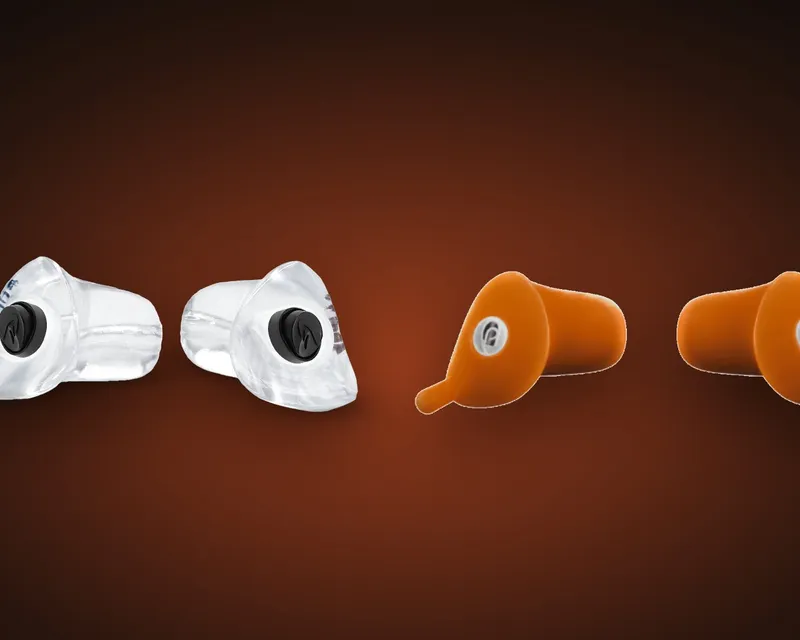
The Audinc Ride is a custom earplug with a built-in speaker and a Kevlar-coated cable. Instead of the speakers in your helmet, you plug the Ride into your Sena or Cardo system. You hear music, navigation and your group through the earplugs, and you talk through your intercom’s microphone. Do check that your system has a 3.5 mm mini-jack; the product page shows which models connect directly or with an adapter.
You choose a 1.2-metre cable, which you tuck away under your clothing, or a short 60 cm cable for a compact set-up. There is a choice of a 6 mm speaker, clear and focused and good for navigation and speech, or an 8 mm speaker with a fuller sound and more bass for music. The cable is detachable, so for a short ride you use the Ride as an ordinary earplug. If you still want to use it wirelessly with your phone, you can do so with the Bluetooth transceiver from our shop.
Audinc Ride Bluetooth: wireless with your phone
The Audinc Ride Bluetooth has the same flat custom earplugs, but with an ergonomic Bluetooth 5.0 cable with a built-in battery and control unit. The battery lasts 20 hours, enough for a long tour. You control your music with the buttons and take calls with the built-in microphone. Note: this version does not work with an intercom system. If you ride in a group with Sena or Cardo, choose the Ride with a cable.
The earplugs of the Ride and the Ride Bluetooth are always made of soft silicone. They do not stick out of your ears, so they are comfortable even under a tight helmet.
Custom Motor: quiet under your helmet
Want to keep your helmet speakers, or would you rather ride without music? Then the Custom Motor is the earplug for you. The motorcycle filter reduces wind noise, while you keep hearing the traffic around you. You choose the strength: from SNR 17 to 19 dB with the medium filter up to 28 to 34 dB with the strongest filter, depending on the material. In the first 3 months we swap the filters free of charge, so you can match the attenuation to how and where you ride.
The Custom Motor comes in soft silicone and hard acrylic. Under a helmet, soft is usually the most comfortable, because there is no hard edge pressing against your ear. The difference is explained in hard or soft custom earplugs.
Custom Pure Tones Motor: natural sound
The Custom Pure Tones Motor has a flat filter that reduces low, mid and high tones by roughly the same amount. Everything gets quieter but still sounds the way it is: you hear your engine, your navigation and the traffic clearly, just not as loud. You choose from four strengths, from SNR 10 to 23 dB, and with the optional Click upgrade you switch to a stronger filter of SNR 28 dB with one press. Because the sound stays so natural, many people also use this earplug at festivals and concerts.
Audinc Bluetooth: on the go
The Audinc Bluetooth combines custom ear tips with the wireless JBL Tune 135BT. You get up to 25 hours of battery life, multipoint to pair two devices at the same time, and it is splash-proof (IPX4). It is made for everyday use, sport, the train or the bike, not specifically for under a motorcycle helmet. If you want to listen wirelessly while riding, the Ride Bluetooth is the earplug that sits flat under your helmet.
Still not sure? Answer two questions and see which earplug we would recommend:
Product finder
Which earplugs suit you?
Two questions, and you’ll see which earplug we would recommend.
What do you need hearing protection for?
Music and going out
How do you want to hear the music?
Sleep
What do you mainly want to keep out?
Work
What kind of noise do you have at work?
DIY
What do you mostly use for DIY?
Motorcycling
What matters most to you under your helmet?
Swimming and surfing
What do you want in the water?
Shooting and hunting
Do you want to keep hearing ambient sound and conversations?
Two-way radio and security
Do you also work in loud noise?
Our advice
Custom Music
€128.95
SNR 17–31 dB (Click up to 34)
A tube filter that makes music sound a little warmer, in several strengths.
At your appointment you choose the material: soft silicone is the most comfortable for long wear and under a helmet, hard acrylic lasts longer and is easy to put in.
Our advice
Custom Pure Tones
€159.95
SNR 10–23 dB (Click 28)
A flat filter that attenuates low, mid and high tones almost equally: the music stays balanced.
Our advice
In-ear monitoring
from €539.95
Isolation up to 35 dB
Your own monitor mix in your ears, with the seal of a custom earplug.
Our advice
Custom SleepzZ
€119.95
Maximum attenuation, no filter
Soft silicone and no filter, as quiet as possible. Comfortable for side sleepers too.
Our advice
Custom Work
€106.57 excl. VAT
SNR 17–31 dB (Click up to 34)
A work filter that attenuates noise while you can still understand your colleagues.
At your appointment you choose the material: soft silicone is the most comfortable for long wear and under a helmet, hard acrylic lasts longer and is easy to put in.
Our advice
Custom Impulse Work
€128.06 excl. VAT
SNR 21 dB, peak up to 34 dB
Attenuates constantly and extra hard on bangs, so you can talk normally in between.
Our advice
Custom Porto Protect
€149.00
Radio on one side, attenuation on both sides
Both ears are protected against noise and you hear your radio clearly.
At your appointment you choose the material: soft silicone is the most comfortable for long wear and under a helmet, hard acrylic lasts longer and is easy to put in.
Our advice
Custom Porto
€99.00
Ear stays open
A custom earpiece for your two-way radio that stays in place for your whole shift.
At your appointment you choose the material: soft silicone is the most comfortable for long wear and under a helmet, hard acrylic lasts longer and is easy to put in.
Our advice
Custom Hobby
€128.95
SNR 17–31 dB (Click up to 34)
Attenuates the noise of power tools while you still hear what is going on around you.
At your appointment you choose the material: soft silicone is the most comfortable for long wear and under a helmet, hard acrylic lasts longer and is easy to put in.
Our advice
Custom Impulse
€154.95
SNR 21 dB, peak up to 34 dB
An impulse filter that attenuates harder the louder the bang.
Our advice
Custom Motor
€128.95
SNR 17–34 dB (choice of filter)
Attenuates wind noise while you keep hearing the traffic around you.
At your appointment you choose the material: soft silicone is the most comfortable for long wear and under a helmet, hard acrylic lasts longer and is easy to put in.
Our advice
Custom Pure Tones Motor
€159.95
SNR 10–23 dB (Click 28)
With a flat filter: everything gets quieter but still sounds the way it is.
Our advice
Dry Ears
€119.95
Water filter (SNR 5 dB)
Keeps water out while you can still hear the lifeguard or your coach.
Our advice
Dry Music
€229.00
Waterproof MP3 player (8 GB)
Custom swimming earplugs with a built-in waterproof MP3 player and 16 hours of playtime.
Our advice
Cens
€929.00
Active: shots are attenuated automatically
Electronic: amplifies ambient sound and conversations, and attenuates shots automatically.
How the fitting works
We take impressions of your ears at one of our locations in the Netherlands or Belgium, or in Paphos on Cyprus, where you book by phone or WhatsApp. Allow about 20 minutes for the whole appointment. Not near one of our locations? Have impressions taken locally and send them to us. What exactly happens at the fitting is explained in fitting earplugs: how does that actually work?
We make the earplugs in our own 3D lab in Eindhoven, the Netherlands. The production time is 15 working days, and rush orders are possible. You get at least 2 years’ warranty on the material and a 6-month comfort guarantee: if they still do not fit well after you have got used to them, we adjust them free of charge. More tips to protect your ears, also off the bike, can be found in tinnitus prevention.
Custom motorcycle earplugsLess wind, but still your music and navigationFlat under your helmet, with or without speakers. Ready in 15 working days. View motorcycle earplugsSources
- Behar, A.: Motorcycle noise, part II, Canadian Audiologist (wind noise by speed, attenuation of helmets, earplugs as the best protection)
- Dutch government (Rijksoverheid): Rules for motorcycles (in Dutch; no holding electronic devices; hands-free calling and listening to music are allowed, without endangering other traffic)
- Dutch Traffic Rules and Signs Regulations 1990 (RVV 1990), article 61a (in Dutch; ban on holding a mobile electronic device while riding or driving)
- French Ministry of the Interior, Sécurité routière: Press release on the ban on earphones, earbuds and headphones while driving (in French; 18 June 2015; also applies to motorcycles, helmet systems remain allowed, €135 and 3 points; Spain since 2003)

Got a question? We're all ears.
Frequently Asked Questions
Read MoreFAQ
That depends on the country, because there is no single EU rule. In the Netherlands, for example, there is no separate ban on earphones or earplugs on a motorcycle, but you may not hold a phone or music player while riding. Hands-free calling and listening to music are allowed there, as long as you do not endanger other traffic. France and Spain ban earphones while riding. So check the rules of every country you ride through, and keep the volume low enough to hear sirens, horns and other traffic.
Measurements under the helmet come out at around 90 dB(A) at 60 km/h, rising to 110 dB(A) at 160 km/h. At motorway speed you are at around 100 dB. Following the rule of thumb of 80 dB(A) for 8 hours, where every 3 dB louder halves the time, you reach your daily dose at 100 dB after only about 5 minutes.
No. A helmet protects your head, but it only reduces noise to a limited extent, especially the low tones of wind noise. Part of the noise is also created by the helmet itself, as the wind rushes past the chin, the neck and the visor. That is why earplugs under your helmet are the most direct protection.
Yes, in two ways. You can wear ordinary motorcycle earplugs with a filter and keep using your helmet speakers. Or you choose earplugs with built-in speakers, such as the Audinc Ride, which you plug straight into your intercom with a 3.5 mm mini-jack. Do check that your system has that connection. The Ride Bluetooth does not work with an intercom, only with your phone.
No. Since 1 July 2015, France has banned wearing anything in or on your ear that can play sound while riding or driving. That includes motorcyclists. Systems built into the helmet, such as helmet speakers, are still allowed. Ordinary earplugs without a speaker are not covered by the ban. Spain also bans earphones while riding.
Yes. Motorcycle earplugs with a filter mainly reduce the loud wind noise, while you keep hearing traffic, sirens and your engine. With the Custom Motor you choose the filter strength. With the Custom Pure Tones Motor, a flat filter reduces all tones by roughly the same amount, so everything gets quieter but still sounds natural.